Author: xbzg

Somatic therapy – working with the body in psychotherapy
in GestaltThis article offers a guide for therapists to work with the whole body. For some of the philosophical roots of this practice you can check this article focused on Merleau-Ponty’s body phenomenology. — Somatic therapy brings together both the cognitive and physical sides of our existence through the anti-Cartesian proposition that our thinking-verbal and affective-non-verbal…
The Gestalt cycle of experience
in GestaltThe Gestalt cycle of experience is a model in Gestalt therapy originally developed by Perls to show the process of organism/environment interaction by which we organise ourselves to accomplish our goals (e.g satisfying hunger, making friends, finding a Post Office). It serves as a map of each singular experience as a sequence of events in…
Therapist anger: to express or not to express
Much attention has been given to the arousal and expression of anger from clients in therapy (Lewis et al, 2008; Greenberg, 2015). Meanwhile, the therapists’ own experiences of anger are often considered taboo, unresolved personal issues or unproductive countertransference. For example, Freud considered the relational aspect of the therapeutic work a matter of transference and…
Together Alone: Loving is the answer
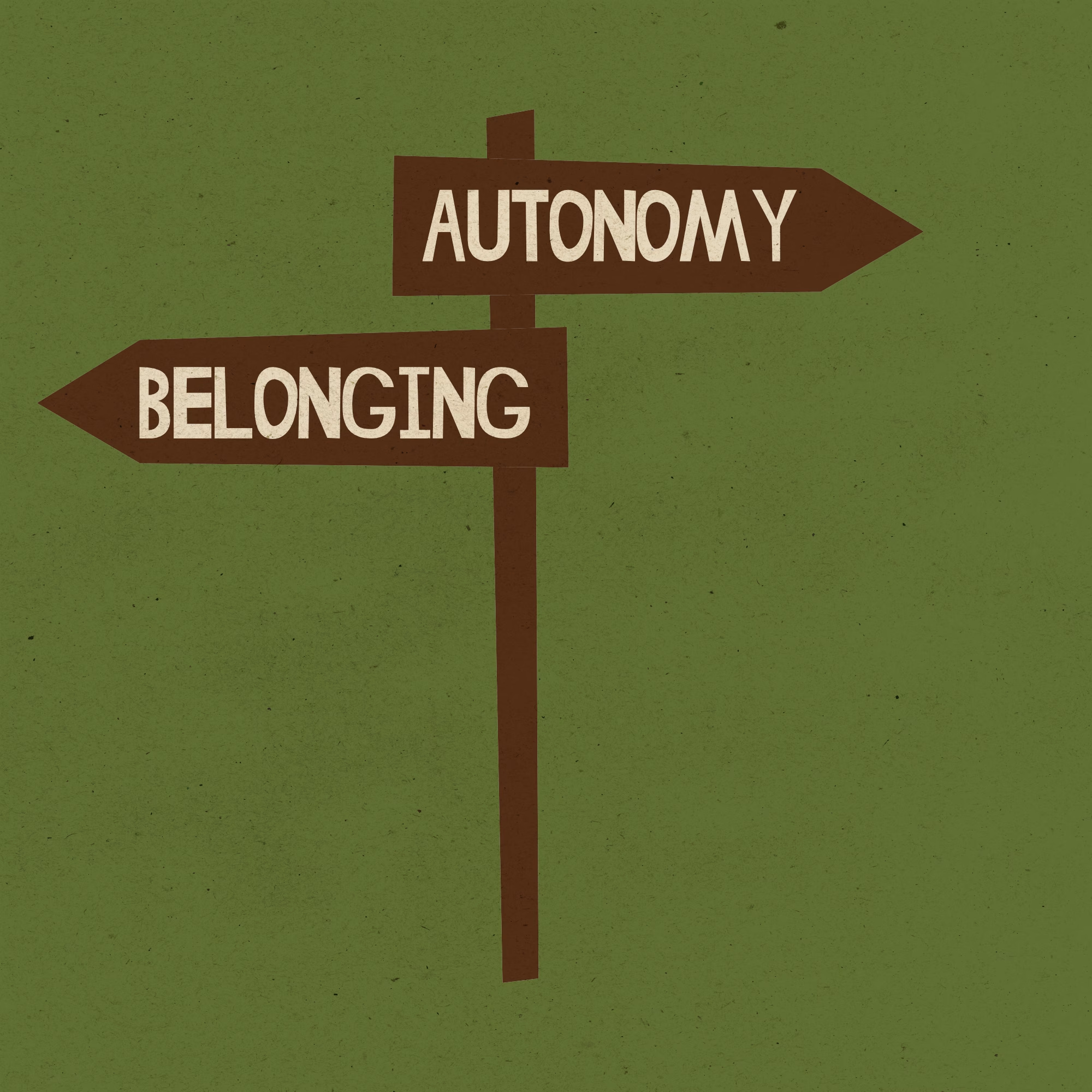
How do we live alone in this world full of people we depend on? This question sums up the dilemma at the heart of our existential aloneness and togetherness. Alongside death/life, freedom/responsibility and meaning/chaos, the paradox of our isolation and our mutual dependency is a pillar of Yalom’s existential psychotherapy (1980, 1988). Emmy van Deurzen considers…
We will die: overcoming death anxiety
How do we live our lives knowing we will die? This question lies at the centre of the project of overcoming death anxiety: the often unacknowledged fear that arises from the fact that we will inevitably die. I will explore death anxiety and death acceptance as two possible responses to the existential reality of life…
An existential map: Four dimensions of existence
The Existential Map is a framework for existential therapy by Emmy van Deurzen that helps us live to our fullest expression by gaining mastery over life’s challenges and tribulations. It is made up of four dimensions of existence. Each dimension is “a playground of paradoxes and contradictions” (Deurzen, Arnold-Baker, 2018) where our lives unfold with goals,…
Ego states: Child, Parent, Adult and how to make them work
Ego states are ways of being that emerge within us in different situations. As a concept, they are very much “the heart of transactional analysis” (Sills, Hargaden, 2003), a therapeutic modality that effectively combines psychoanalysis, humanistic philosophy and pragmatism. Ego states can be understood in many ways, and these all can be helpful: Ego estates…
Patience, focus and boredom
in JournalThis month has been a good test: nothing good has happened, I haven’t achieved any of my current priority goals and I still feel deep into my chronic inflammation recovery post-celiac diagnosis. In short, January has sucked a fair amount. This has allowed me to explore three ideas: patience, focus and boredom. My flat is…
We are bodies: ideas from body phenomenology
We are bodies. This is the main argument in the article, which I will make through a series of ideas from phenomenology – an orientation in philosophy interested in the world as it’s experienced. Bodies are “holding fields” (Sills, 2006) of various systems leading to our experience. And our experience of the world is all…
Year Note 2025
This is the first Year Note that I ever write, and I think a good place to start is a bit of context. It had been the previous year when I had decided to study counselling and work towards a career change. At that time, my marketing career was in the ruins after a couple…