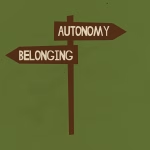
How do we live alone in this world full of people we depend on?
This question sums up the dilemma at the heart of our existential aloneness and togetherness.
Alongside death/life, freedom/responsibility and meaning/chaos, the paradox of our isolation and our mutual dependency is a pillar of Yalom’s existential psychotherapy (1980, 1988). Emmy van Deurzen considers this paradox as the central source of dilemmas in the social dimension of her existential map. (1997)
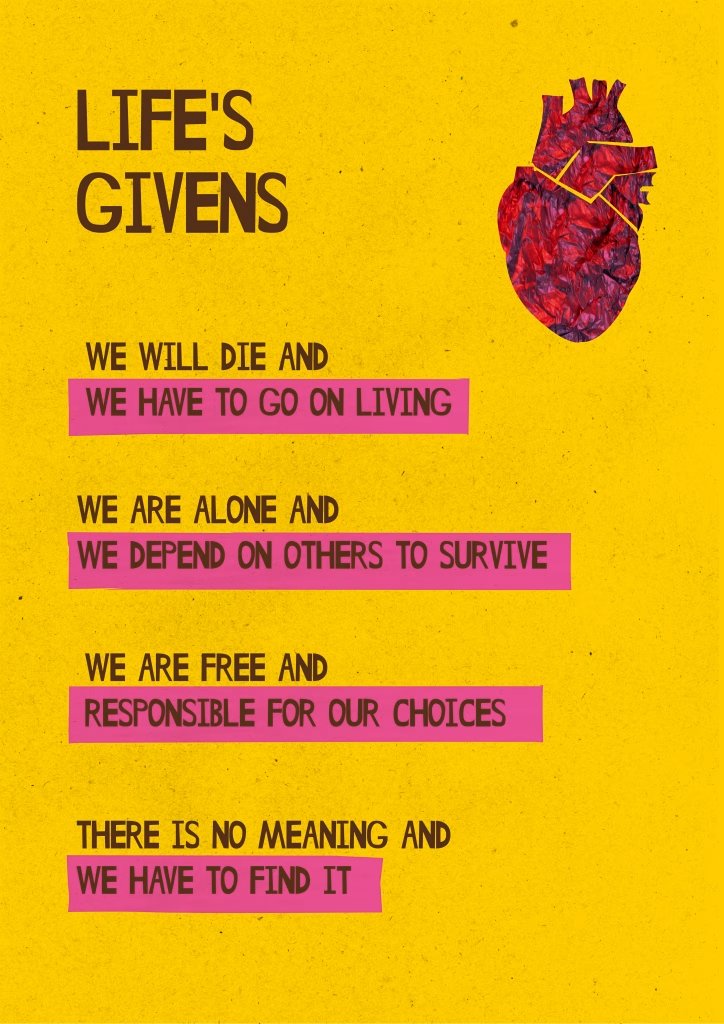
Buy this as a poster
It is the paradox of human existence that man must simultaneously seek for closeness and for independence; for oneness with others and at the same time for the preservation of his uniqueness and particularity
Eric Fromm
This article analyses both sides of the paradox (we are alone, we are together) and proposes “need-free” love (Yalom, 1980), companionship and belonging to face our existential isolation and for having meaningful and healthy interpersonal relationships.
The relationship between aloneness and existential anxiety
This is the starting point: we are alone. Nobody will die our death for us. Nobody thinks our thoughts or feels our feelings. Nobody bears the consequences of our choices. Nobody can genuinely give our life meaning. Only we can do that.
This is a source of deep stress, and Yalom argues it’s something we actively defend against with a range of strategies. The problem is, these strategies limit our potential and wellbeing.
He gives the example of a woman who experiences alcoholism and hides it from everyone. An important realisation in the process was that whilst the woman thought she was hiding from others her alcoholism, it was in fact that she was drinking so that she didn’t have to face her feelings of existential isolation which in turn prevented from relating well to others in the first place.
This illustrates the vicious circle between existential isolation (the inevitable fact of our aloneness) and interpersonal isolation (a situated separation from meaningful relationships). The more we’re unable to face our existential aloneness, the more compromised our pattern of relating will be, the more alone we will feel.
Therefore, back to the woman above, developing healthy ways to relate to others and use those to grow personally and be strong enough to develop capacity to be alone was the way to overcome alcoholism.
These are some of the (faulty) strategies in which we may seek to alleviate our existential anxiety related to our aloneness.
Fusion
Fusion is a protective strategy against existential isolation where we swallow, merge or dissolve into others (similar to “belief in a rescuer” in death anxiety).
Fusion can be directed towards others – a daughter/son, a partner, a teacher, a mentor, a political leader – or more generally towards ideas – a spiritual practice, a cult, a political movement. At times when people face more isolation, ideas become more appealing in that they may provide us with readily available fusion and meaning.
When we seek to fuse with another, we relate to others as objects that can do something for us – protect us, praise us, defend us, agree with us. This introduces needs in our relationships that prevent us from loving others properly. We neglect to understand that others are equally frightened to live in separate bodies in an uncaring universe.
Another fundamental issue in fusion is that we neglect our needs. This can lead to another source of existential anxiety and associated faulty strategies: meaninglessness.
Existing in others
Being chosen and valued is another type of faulty strategy to calm our existential anxiety related to our isolation. For many of us, at times in our life knowing that we are in someone’s mind makes us feel less alone.
As with fusion, the problems are apparent. We spoil our relationships by needing to be affirmed, becoming self-centred and neglecting to see others as subjective beings. As we will see later, we seek for love instead of loving, and that only postpones the problem of recognising our fundamental isolation for later stages in life, when we may actually be more fragile.
The given of togetherness
Togetherness – understood as the inevitable fact that we exist in relationship – is the paradoxical other side of our social human condition.
If I think of me as a baby, I could not have survived, let alone thrived without my mother looking after me. As Winnicott says, “there is no thing as a baby, only a baby and their mother”. That is the case as adults too. Could we survive without all the other people fulfilling roles in our societies and economies?
Our togetherness makes us who we are as individuals too. We only exist as an independent self through others. It is in relation with others that we have the foundation upon which we can build a “sense of me” in the first place.
The challenges of our togetherness are co-operation and belonging. We need to be able to stand our ground and negotiate with others to get our needs met, whilst at the same time be willing to compromise and respect others as subjective beings.
Neither dominating, nor fully submitting to others are satisfying solutions, as both ultimately lead to isolating too. It is a common complaint for corporate leaders that it “feels lonely at the top”. They have lost the self-awareness to realise their predicament is of their making. And those who have lived through self-sacrifice also feel alone, treated as objects while others live more meaningful lives. They, too, have lost the self-awareness to realise they treated others as rescuers and protectors in the first place.
Loving is the answer
“How can I be an I in a we”, proposes Sue Sully: a need to find a balance between our existential isolation and our fundamental relational nature.
For Yalom, loving in the answer (1980). Loving provides an answer for how we can engage meaningfully in relationship with one another, balancing closeness and independence.
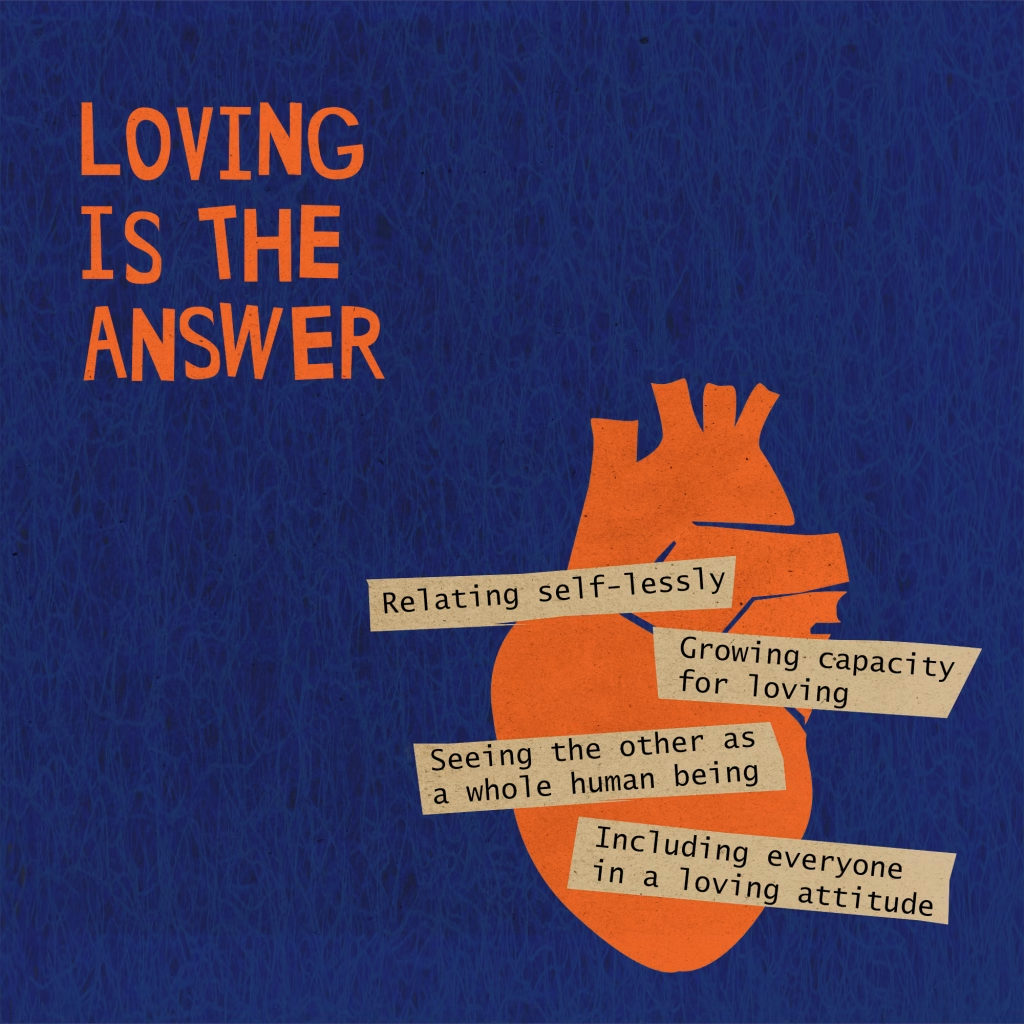
Healthy love is not about dissolving into the other or using them to escape loneliness, but about meeting another person as a separate being while remaining oneself.
If we can love need-free, arriving without an agenda, loving with our whole being, then we can transcend our utilitarian anxious selves and gather the strength to live in the world.
Loving is a way of being. It’s not about falling in love with a person, but about embracing a self-less attitude of giving, caring and relating to others as whole persons – also conflicted, scared, alone. It’s loving for loving’s sake, trusting that enlarging our capacity for caring for others is more like a muscle we can exercise than a resource we can deplete.
What does “loving as a way of being” look like in daily life? It means noticing when we need others or try to manipulate them and reflect on what fears are sustaining those attitudes. Or noticing when we try to change a person or wish they were different. Importantly, it means to appreciate people for what they are, in all their human complexity, including ourselves: to accept, forgive, respect and care. In Buberian terms, “love is responsibility of an I for a You (Thou)”, a plea to engage with others as shared subjectivity.
It doesn’t mean to submit to others’ wishes and forget our needs. Rather, to develop a full appreciation of what it means to be human – with its pains, joys, worries – and to see that in everyone. To equalise: we are neither more, nor less than others and… isn’t that wonderful?
Bibliography
Buber, M. (1970) I and Thou. New York: Scribner.
De Beauvoir, S. (1947) The Ethics of Ambiguity. New York: Philosophical Library.
Fromm, E. Man for Himself: An Inquiry into the Psychology of Ethics (1947)
Van Deurzen, E. (1997) Everyday Mysteries: Existential Dimensions of Psychotherapy. London: Routledge.
Yalom, I.D. (1980) Existential Psychotherapy. New York: Basic Books.Yalom, I.D. (1989) Love’s Executioner and Other Tales of Psychotherapy. New York: Basic Books.
Winnicott, D.W. (1965) The Maturational Processes and the Facilitating Environment: Studies in the Theory of Emotional Development. London: Hogarth Press.