This article offers a guide for therapists to work with the whole body. For some of the philosophical roots of this practice you can check this article focused on Merleau-Ponty’s body phenomenology.
—
Somatic therapy brings together both the cognitive and physical sides of our existence through the anti-Cartesian proposition that our thinking-verbal and affective-non-verbal bodies are one (Sills, 2012).
It proposes that gaining awareness of our physical manifestation, making meaning of it and revealing its linkage to our past experiencing and presenting attitudes is healing (Reich, 1933/72; Perls, 1951/76; Kepner, 1978/83; Frank, 2001). Unlike yoga, tai chi, rolfing, aikido and other body-focused techniques that work with the body by controlling the mind, somatic therapy recognises that the complex problems of therapy require the integration of cognitive, emotional and sensory systems in the nervous system (Herbert, 2006).
The meaning of our body organisation
One of the fundamental insights in body-oriented therapy is that the totality of past experiences is embodied in our present body emergence, what Reich called body character structures (Reich, in Sletvod, 2011).
Merleau-Ponty explained that our “momentary world” during a “formative element of my whole life” creates a structure that survives not as an episodic memory but as a general way of being (1945/62), an insight echoed in the work of van der Kolk who highlights how these memories have little capacity for verbal presentation (2014). These patterns do not disappear, remaining within the phenomenological present even if what was once a creative adjustment has now become harmful (Frank, 2001).
The role of the therapist working from a humanistic paradigm is to notice and aid exploration of these body structures to reveal their meaning, disorganise them and open up alternative expressions.
Our bodies are deeply interconnected with everything around us, co-created inextricably from the environment (Merleau-Ponty, 1945/62; Gendlin, 1978/2003, Frank, 2001), making body character a relational field event that emerges dynamically where all of those present in the field are influencing each other’s experience (Frank, 2001). This reveals our embodied experience as a series of “dances” in relational fields in which we co-emerge alongside other bodies and objects. (Clemmens, 2020)
Therefore, a key question when working from an embodied relational frame is “is this our work?” (ibid). Rather than a distanced, cool omniscient observer that identifies, classifies and dissolves body structures or rigidified patterns, I am most interested in joining the dance and forming a pair with my client so that we can move together and find meaning to our being.
How to work with the body in psychotherapy
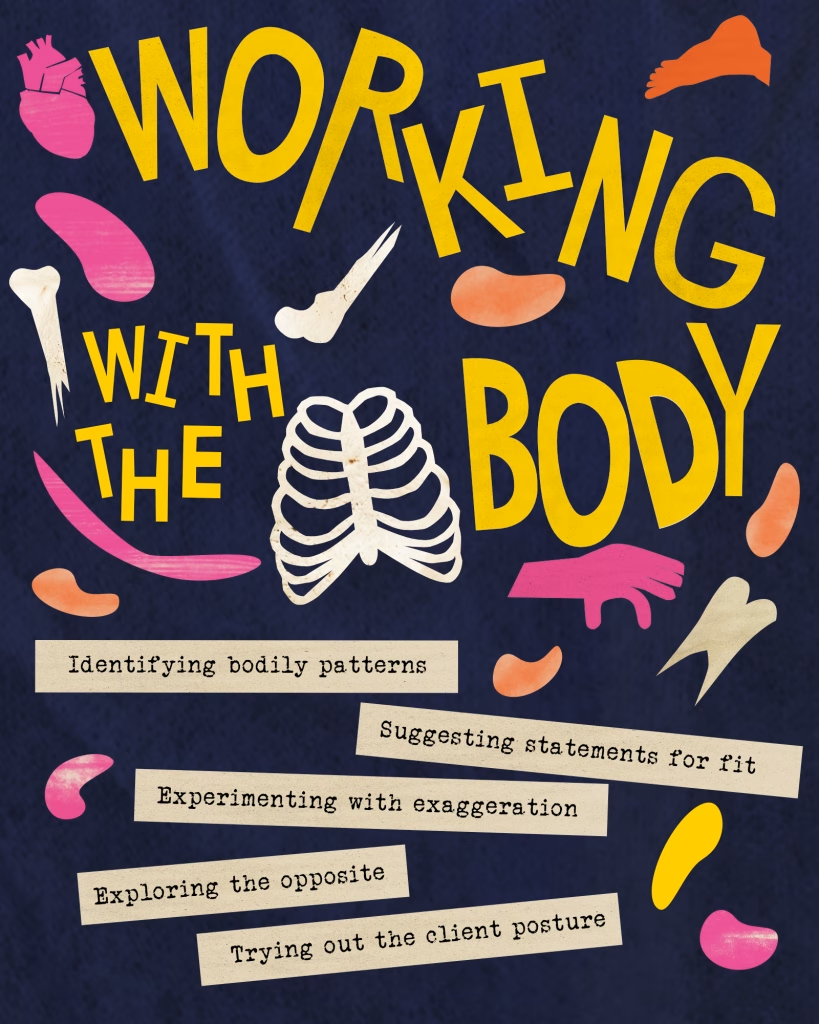
Now I will suggest a series of experiments – ways to dance – to work with the body-self coming from Gestalt tradition from theorists such as Fritz and Laura Perls, James Kepner and Ruella Frank.
Identifying patterns
The theory of change in embodied relational therapy is to increase the client’s awareness of what is meaningful to them (Yontef, 2005) and assist with healthy differentiation within the field, so the person can see themselves as both different from and part of the environment (Frank, 2001).
Therefore, paying attention to how the person is organising their body around their experience gives us valuable information (Sills, 2012). When we identify variations in body structure, we want to raise awareness and ownership of them (Kepner, 1987/93) so that they become flexible, available to use and revealing of important, unassimilated material (Frank, 2001).
This is what Garcia, working from a Merleau-Pontian tradition terms a cross-salience: an interaction from the therapist’s reflective intentionality (“I have noticed something and think it may mean something”) towards the client pre-reflective intentionality for them to move it towards reflective intentionality, a process in which meaning can be made, symbols can be formed and possibilities can be revealed (2025).
Suggesting statements for fit
To help the client make meaning of a specific body organisation, the client is encouraged to see it as an intrinsic part of their existence. For this, Kepner (1987) suggests that after developing sensory grounding, the client needs to engage their meaning-making and own their body pattern as something meaningful they do. For this, he suggests that the client “tries a statement” until they find one that fits. For example:
“I am folded over, and this is my existence”.
“I make myself small, and this is how I am being”
“I walk fast everywhere”
“I am so empty inside”
Only when the client finds a statement they are happy to repeat and own, work can continue. It’s perfectly OK to try statements that seem at odds, just to see how they fit. We are looking for an aesthetic fit, a bodily felt sense of rightness that those words represent the client’s experience.
Experimenting with exaggeration
When the therapist invites the client to exaggerate a specific body organisation, awareness heightens. The client has little time to calculate his maneuvers or maintain control over his behaviors. The emerging and spontaneous material can be a surprise to the client who has kept it so repressed that it is a secret even to himself (Frank, 2001).
Noticing something subtle, the therapist may ask the client to focus on it and enlarge it. An innocent swinging of a foot can become a prototype kick, a form of aggression. A lowering of tone of voice can become an attempt to not be heard, to disappear. A hearty laugh can become farcical and reveal tears behind it.
Exploring the polarity
Another layer of experiments revolve around understanding every body organisation as a process of polarities. Whatever the client is doing has a counterpart that is being neglected or acted against.
Exploring both sides of an organisation – the original and its counterpart – gives a wider range of related feelings that aid in meaning making. A client that normally makes themselves small, can experience fear of being exposed when exploring postures that make them bigger.
In addition, it can be helpful to identify parts within that are “doing” the different organisations. Who is making myself small and what are they protecting me from? How do I really feel about having a part within me making me feel small?
This can start a fruitful dialogue between parts, revealing contrasting needs, internal conflicts and neglected ways of being.
Trying out the client posture
Finally, the therapist can try the posture of the client and report their own feelings from it. This can be combined with exaggeration and polarities in order to recreate the full range of possibilities.
For example, someone that presents shrunk and deflated may experiment with raising themselves while the therapist tries the original posture of the client. This allows them to exchange their own feelings. As Frank reports after trying their client’s posture:
‘I have deflated my lungs and compressed my spine, and I look up at them. “I feel so small, and you are so big. I’m angry that you get to be so big and I’m stuck with being little.”
Karla is struck by both my posture and my statement.
“Do I look like that? Maybe I’m really angry too.”
Conclusion
The experiments briefly suggested allow client and therapist to embody their experience, engage in a pre-reflective dance and kickstart a process of meaning-making that reveals possibilities within the field.
Working with the body can cut through the natural defences and rigidified unassimilated ways of being of the client, accelerating insight as well as opening up new paths of expression.
References
Clemmens, M. (Ed.). (2019). Embodied Relational Gestalt: Theories and Applications (1st ed.). Gestalt Press.
Frank, R. (2001) Body of awareness: a somatic and developmental approach to psychotherapy. Cambridge, Mass: Gestalt Press
Garcia, E. (2025) ‘Participatory sense-making in therapeutic relationships’, Journal of Humanistic Psychology, 65(5), pp. 1187-1207.
Gendlin, E. (1978/2003). Focusing. Ebury Publishing, London/
Gilligan, S. (2008). Gestalt therapy in Haugh, S. and Paul, S. (2008) The therapeutic relationship: perspectives and themes. Ross-on-Wye: PCCS Books.
Herbert, C. (2006) ‘Healing from complex trauma: an integrative 3-systems approach’, in
Kepner, J. (1987/93) Body Process: Working with the Body in Psychotherapy. Gestalt Press.
Merleau-Ponty, M. (1945/62) Phenomenology of perception. Translated by C. Smith. London: Routledge & Kegan Paul.
Perls, F., Hefferline, R. and Goodman, P. (1951) Gestalt Therapy: Excitement and Growth in the Human Personality. New York: Julian Press.
Reich, W. (1933/72) Character analysis. Translated by V. Carfagno. Wilhelm Reich Infant Trust Fund
Sills, C., Lapworth, P. and Desmond, B. (2012) An Introduction to Gestalt. London: SAGE.
Sletvold, J. (2011) ‘”The Reading of Emotional Expression”: Wilhelm Reich and the History of Embodied Analysis’, Psychoanalytic dialogues, 21(4), pp. 453–467.
van der Kolk, B. (2014) The Body Keeps the Score. London: Penguin.
Yontef, G. (2005), in Woldt, A.L. and Toman, S.M. (2005) Gestalt therapy: history, theory, and practice. 1st edn. Edited by A.L. Woldt and S.M. Toman. Thousand Oaks, Calif;London;: Sage Publications.