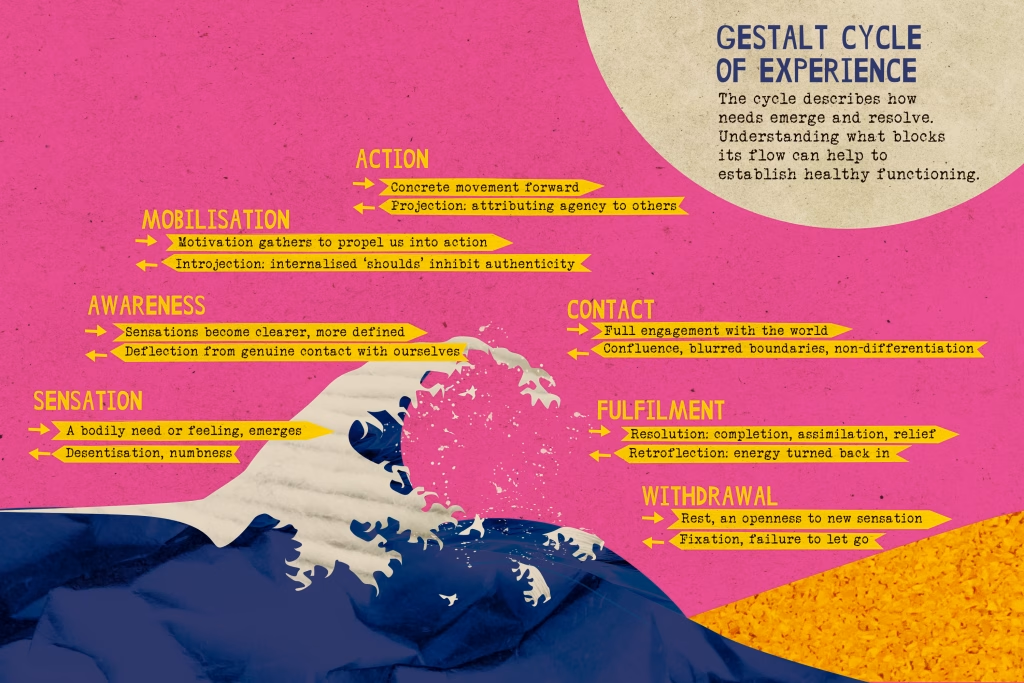
The Gestalt cycle of experience is a model in Gestalt therapy originally developed by Perls to show the process of organism/environment interaction by which we organise ourselves to accomplish our goals (e.g satisfying hunger, making friends, finding a Post Office).
It serves as a map of each singular experience as a sequence of events in which the organism seeks self-regulation: from noticing an opportunity or a risk in the organism/environment to taking relevant action and finally, withdrawing attention.
Each experience is composed of the same sequence of stages, however how those stages play out is unique each time. Sometimes, the whole cycle may flow in seconds, for example when we notice our thirst and reach out for a bottle of water. At other times, the cycle can take months or years, for example when we buy a house: a big complex project full of uncertainty.
Yet at other times the cycle may be interrupted forever, for example in a miscarriage. This can lead to “unfinished business”, a feeling that can haunt us and stop us focusing on what’s happening in front of us. If we are in the middle of a “fixed Gestalt”, it means we haven’t withdrawn our energy from it and are therefore unable to deploy it for new projects wholeheartedly.
This is why Gestalt places emphasis on understanding how figures from the past haven’t been completed and what can be done to complete or let go of those fixed experiences.
At any given time, we may be in process for multiple projects: we start new projects while we put some others on hold and finish others. The cycle of experience can help us map which processes are we cycling through, which ones have been left unfinished and which ones we may need to re-appraise.
In addition, Gestalt proposes potential blocks to the process. Becoming aware of these blocks helps our healthy functioning and flow through the cycle.
The stages of the Gestalt cycle of experience
Sensation
In the first stage, we become aware of something – a thought, a feeling, a sensation.
We hear the alarm in the morning. We notice a negative thought about our partner. We feel thirsty.
Awareness
Awareness is the moment when that something (blurry, undefined, vague, general) becomes a figure against a background. It is now more defined, more clear, it has more meaning and has therefore commanded our attention.
We realise it’s time to wake up. We consider whether we still love our partner the way we used to. We say to ourselves “I need some water”.
Mobilisation
Now aware of this object of our attention we gather our motivation to take action.
We breathe deep and run through our heads how we’re going to move to sit up. We decide we need to think deeper about our relationship. We cast an eye towards the bottle of water.
Action
Action is the concrete movement or execution of the plan we have made during the mobilisation stage.
We sit up. We go for a walk to think things through. We reach out for the bottle.
Contact
Contact is our ultimate reality (Perls, Goodman, Hefferline 1951). This is the moment where all the mental and physical preparation and actions gets us into intercourse with the figure in the environment. This is when things really happen, the part of the cycle that deals with what Csikszentmihalyi refers to as “flow” (1990).
Gestalt is deeply concerned with this stage of the process, considering it most important that we are in healthy contact with the diverse aspects of our environment.
Following our examples, contact is the embodied experience of the action of waking up in the morning as a result of hearing the alarm – and in turn our plans from yesterday – to behave in this way. For the person engaged in thoughts about the quality and nature of their relationship, contact is their focused attention in considering this problem. Finally, for the person reacting to a sensation of thirst, contact is the drinking of the water.
Fulfilment
Contact can begin to end when there is a satisfying resolution to the goal or need that has been raised. An important element of this stage is the assimilation of the experience.
For the person that woke up to the alarm, the alarm (and the bigger process of morning routines and habits) has been processed. The experience has become part of who they are now: a person that has woken up from an alarm one more time and has therefore experienced the benefits and drawbacks of doing it. This may go into affecting their belief systems (about morning routines, but perhaps also about discipline, perseverance) and change them in subtle but important ways.
What about the person drinking? Perhaps they haven’t changed dramatically in terms of their philosophy of life, however their body has undergone profound transformation and Gestalt would encourage us to pay attention to that: to feel how our body has reacted from receiving the molecules of water and absorbing them.
It could also happen that despite the action and contact the need remains and there is a re-appraisal of how to deal with the sensation, or a decision to come back some other time for more contact. After all, complex important processes can’t naturally complete in a short space of time and we need to pay attention to multiple other processes and needs in the meantime.
It’s likely that the person that went for a walk to think about their relationship hasn’t completed this process before dinner. They will work on this process in a succession of interrupted contacts as the figure (the problem, the situation) evolves in its definition.
Much suffering comes from unfinished business, and much unfinished business comes from an inability or unwillingness to integrate the experience into our being. A good example of this are traumatic experiences: there was contact with the environment but we weren’t able to properly cope with it and the experience became frozen, stuck. Different theories offer models to understand this process of stuckness – for example Internal Family Systems. For Gestalt, this is a “fixed gestalt”, an habituated response to a past experience that prevents from treating new experiences as fresh and fluid (Sills, 2012)
Withdrawal
Finally, we let go. If we are satisfied with the contact, meet our need or accomplish our goal we withdraw our energies to deploy them with new processes.
Modifications to contact
There are many ways in which the Gestalt cycle can be interrupted, leading to unfinished business, which we briefly covered above.
These blocks, interruptions or modifications to the process are the ways in which we stop the cycle from flowing and natural, aware, healthy contact from the environment. However, we can consider how these processes are themselves forms of contact – creative adjustments that served us in the past but have now become unhelpfully fixed. Becoming aware of them can help us regain healthy functioning.
Each modification of contact is commonly associated with a stage in the process, however they can also occur at any time and block any part of the process.
Desensitisation
This is the process that numbs our experience of the environment, blocking feelings and sensations from being perceived at all. We can achieve this through our own behaviour (e.g drinking alcohol), our own belief systems (“boys don’t cry” – see introjection below) or our lack of embodiment (e.g a propensity to intellectualise everything).
Deflection
With this process, we divert our energy into distractions or alternative figures to avoid what became our object of attention.
As an example, deflection is a common creative adjustment to death anxiety, with multiple culturally sanctioned conventions to avoid contemplating our own mortality. Another popular form of deflection is procrastination, where we avoid a feeling associated with a task/project by deferring it.
Introjection
Introjection is the most pervasive of the modifications to contact (Sills, 2012).
An introjection is a rule, statement or way of thinking that has been swallowed without chewing, usually in childhood.
- “It’s not point in being upset about it”
- “I should be the best in the class”
- “I will reap what I sow”
It has never been assimilated and remains as it was internalised, resonating in the present, and preventing us from becoming our authentic selves. Instead, we give up our authenticity in exchange for carrying our parents inside ourselves (an argument central to Transactional Analysis).
What Gestalt invites us to do is to discover these introjects and chew them. Who that isn’t me said that? Do I really believe it? How does it work for me? What possibilities is that denying me of?
Sometimes, things we learn from others are helpful – a process identified by Bandura as social learning (1971). The trick is to distinguish helpful ideas from introjected values.
Projection
Projection – identified as a defence mechanism in classic psychoanalysis – is the process of disowning an aspect of ourselves and placing it in someone else.
Projecting is an act of imagining and fantasy based on facts from the past. Whilst it can be helpful, we need to always remember that we are making an inference and therefore could be wrong. Instead, we want to work phenomenologically: without assumptions, being descriptive, and willing to always verify our thoughts about a situation.
Retroflection
This is the process whereby the energy that was directed towards the environment is turned inwards towards our own body, which holds the actions instead. A classic example is “bitting our lip” which has become an idiom that means “holding back words”.
Anger is commonly retroflected because we are worried about the impact of our anger in others. The problem is that if that anger had to be expressed – to protect our boundaries or defend our values – and wasn’t, we are effectively turning this anger against ourselves and developing an inner critic.
We can reveal some of these retroflections by paying attention to how we organise our own body: tightening the chest, rounding up shoulders or lowering the head may be examples of how our own body takes the retroflected energy.
Egotism
Egotism is a form of self-centredness that prevents us from being fully connected with the here-and-now. Instead, we pay excessive attention to our own “performance”. Did I say the right thing? How was I in that exchange? What did people think about me?
Confluence
Finally, confluence is a merging with the environment that prevents individuation. Confluence is commonly exposed in existentialist literature as a way to escape our freedom/responsibility or as a way to assail our fear of death and aloneness.
Common points of confluence can be family, partners or political leaders. Merging with them takes away our need to develop our own thoughts, make our own mistakes or hold the complexity of our lives.
Bibliography
Bandura, A. (1971) Social Learning Theory. New York: General Learning Press.
Csikszentmihalyi, M. (1990) Flow: The Psychology of Optimal Experience. New York: Harper & Row.
Kepner, J.I. (1987) Body Process: A Gestalt Approach to Working with the Body in Psychotherapy. New York: Gardner Press.
Perls, F., Hefferline, R. and Goodman, P. (1951) Gestalt Therapy: Excitement and Growth in the Human Personality. New York: Julian Press.
Perls, L. (1992) Living at the Boundary, ed. J. Wysong. Highland, NY: Gestalt Journal Press.
Sills, C., Fish, S. and Lapworth, P. (1995) Helping Skills in Gestalt Counselling. London: Speechmark.
Woldt, A.L. and Toman, S.M. (eds.) (2005) Gestalt Therapy: History, Theory, and Practice. Thousand Oaks, CA: Sage.