How do we live our lives knowing we will die?
This question lies at the centre of the project of overcoming death anxiety: the often unacknowledged fear that arises from the fact that we will inevitably die.
I will explore death anxiety and death acceptance as two possible responses to the existential reality of life and death.
To do this, I will use the work of Irvin Yalom, who has given death a central place in his existential psychotherapy 1980, 1988, 2008).
His basic thesis is that death anxiety is always present, often repressed in the background, and that this repression is the cause of much suffering. Facing and accepting death is, in turn, a catalyst for life fulfilment, togetherness and peace.
For Yalom, as for other existentialists like Emmy van Deurzen, facing death is not just for those with an officially diagnosed life-threatening condition but a project for everyone at all times, since death “teaches us how to live” (van Deurzen, 2012)

What is there to be scared of?
Since we do not know what being dead is like, it is not immediately obvious what we fear.
Our reasons will be personal to us. We need to explore them so that they can be worked through in the right way. According to Yalom, these are the fears associated with death:
- My death would cause grief to my relatives and friends
- All my plans and projects will come to an end.
- The process of dying may be painful
- I could no longer have any experiences
- I would no longer be able to care for my dependents
- I am afraid of what may happen to me if there is an after life
- I am afraid of what may happen to my body after I die.
The natural (and faulty) defences against death anxiety
We first realise that we will die as children, often during a period of fascination with death.
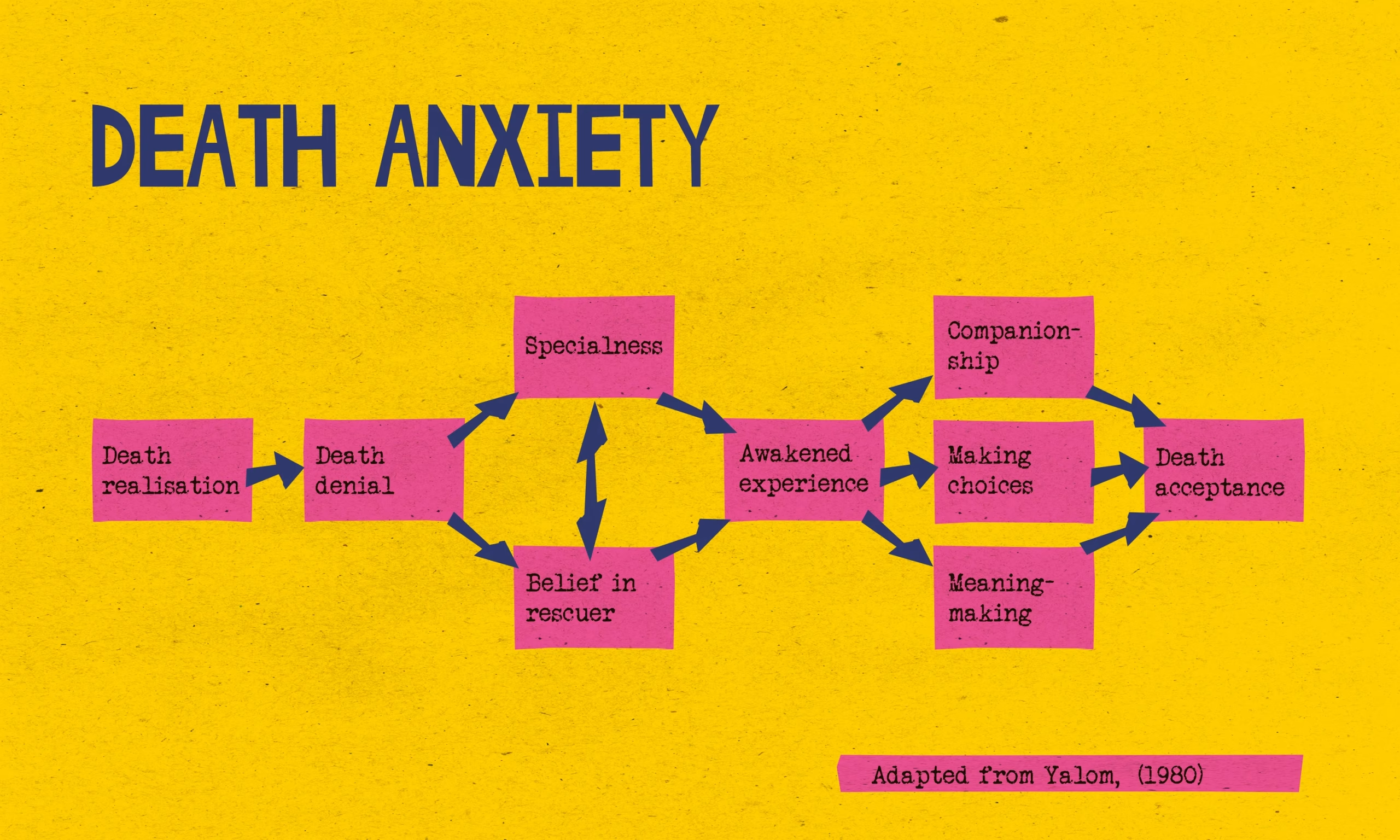
Often with the help of equally frightened adults, we adopt death-denying, life-controlling strategies such as specialness or a belief in a rescuer.
That’s when death goes into its background, constantly repressed and bubbling up through a myriad of other symptoms and rigid attitudes designed to prevent this realisation.
Specialness and belief in a rescuer are diametrically opposed, however they can co-exist, blend or merge. Both strategies do protect us from death anxiety, but crucially prevent us from living our life to its full expression.
Specialness
Specialness is the belief that we are somehow special. Death doesn’t happen to us, we’re young, healthy and on top of that beautiful, smart and kind individuals who can weather any storm.
People who adopt this strategy as a primary defence tend to be expansive, larger-than-life, big-personality types. They tend to over-achieve, over-work and have a lot of personal goals that they frequently meet.
The problem with specialness is that it separates us from others and creates pressure to keep expanding, accumulating and achieving. As life inevitably moves toward decline, illness and limitation, this strategy becomes increasingly difficult to maintain. The result can be stress, conflict, isolation, addiction or frustration.
For a good account of the demise of the special, check this analysis from Arthur Brooks in The Atlantic.
Belief in a rescuer
To believe in a rescuer is to think that there is someone – human or supernatural – that is watching over us and protecting us in some way.
To this protection-seeking person, the thought that we have emerged in an uncaring, chaotic Universe is a deep source of stress to be alleviated with religion, interpersonal submission, self-effacement, marriage or mentors.
People leaning towards this strategy struggle to stand on their ground and find their voice.
Besides neglecting to use death as a teacher-master on how to live, this strategy can leave the person fragile, increasingly dependent on external protection and unsure of their own capacity to act.
De Beauvoir gives a relevant portrait in The Mandarins, where Paula clings to a partner who no longer loves her, eventually collapsing into alcoholism and psychiatric care.
The awakening experience
Thankfully, we can only be cushioned from the deep, dizzying understanding of our finitude for so long. Our specialness gets eroded by illness or a brush with death. Our rescuer dies, leaves or reveals their true nature. All of a sudden, our defences are gone and we are confronted with it.
It’s tempting to think that we never not know we will die, and that even considering this we are not scared after all. This may seem so, but as Yalom argues, there is a difference between knowing and really knowing.
We truly know when something jolts us into recognising that we will die: the awakening experience.
Common awakening experiences may be:
- A life threatening disease, an accident or a near death
- Someone else dying
- Important life events or milestones such as birthdays, retirement or major decisions such as moving home or financial planning.
Once we are awakened, things change: death becomes real, scares us profoundly and opens up the door to a better, more authentic, more enjoyable life. As Yalom explains, “though the physicality of death destroys us, the idea of death may save us.” (2008: 30)
How can this actually happen?
From death anxiety to death acceptance
Yalom’s whole therapeutic framework is based on the idea that human suffering comes from the individual confrontation with the ultimate concerns of existence, what he calls the givens: death, aloneness, freedom and meaning.
Of the four givens, he considers death/life its most central, deeply intertwined with the other givens. Considering the relation between death/life and the other givens can give us a path to transform death – something we naturally fear – into a catalyst for a life well lived.
Facing death as a reality
The first step in accepting death is of course to face it properly.
Cultural norms (with a few exceptions) is that death is something we avoid talking with others or thinking about. The culturally sanctioned methods to keep death as taboo prevent us from having the awakened experience of mortality.
Therefore, we need to go against these cultural norms, by intentionally reflecting on this fact.
Not all cultures are evasive about human mortality.
Buddhists are known for courageously reflecting on death. Death and bodily decay is a common object of meditation. They believe – and so do I, having practiced it – that this exercise promotes peace of mind and acceptance.
Mexico is also famous for its “Dia de los Muertos” festivities where people decorate altars with offers to the deceased. Besides remembering people that were part of us, it can remind us we are next.
The more we practice, the more our defences will fall, allowing us the prospect of death to guide us.
Death brings us together
Once we acknowledge death properly, we need to consider it in relation to our aloneness in the world: “Nobody can die my death for me, it is I who will cease to exist when I die.”
However, it is equally true that part of the human condition is that we all are in this together. As de Beauvoir explained, we think we are the only subject in a world of objects, yet that is something we share with every human being (de Beauvoir, 1948). Just as we will die, so will everyone else; and just as we fear death, so does everyone else.
Therefore, connection and togetherness are key ingredients in our work to accept death.
Not only that, but when we do our work to understand and face our death, we are ready to honour the feelings in other people. This makes us feel – and others – less alone.
One of the saddest things about the way we negate death is that those who are officially dying can sometimes feel like outcasts. They are scared of what to say, and so are those around them. As a result, they end up isolated, accentuating the pain of mortality as something that takes us away from people when in reality is the most important thing we all have in common, the great equaliser.
Death makes choices matter
Death teaches us how to live.
Since we are radically free and responsible for our choices (Kierkegaard, 1980) we feel the burden of making our lives the best they can be, which often clouds our judgment with existential anxiety. We often seek to give up this freedom (Fromm, 1941) with elaborate games of “bad faith” (Sartre, 1957) , for example pretending we have no choice but to do what we are doing such as staying in an unfulfilling job, putting up with a loveless marriage or sabotage our own goals.
Accepting death can help us confront existential anxiety and make our choices count. In turn, intentionally making the difficult choices can raise our acknowledgment and acceptance of our finitude.
A colleague nearing retirement once told me they had spent “a ridiculous amount of money” on a holiday. They were quite conflicted about this, however, as they continued “you can’t take it with you”. I was in awe at the growth in this person who was clearly making the most of her final years and overcoming some previous compulsions to save money and limiting their needs and wishes.
Death gives life meaning
Finally, death gives life its meaning. That’s only indirectly true, because it is us who makes our life worth living (de Beauvoir).
What death does is to give urgency to find meaning, a reason that we are here, a purpose. We need this because we are meaning-seeking creatures (Spinelli, 2008)
Meaning tells us why we are living, but also how we should live since meaning gives way to values (Yalom, 1988).
As with the other givens, death anxiety is all the worse when our life is not firmed with meaning. It is common for people in later life to feel their life is senseless and meaningless, making death anxiety even worse in a vicious circle.
Meaning is a slippery concept, since the inescapable fact is that we are seeking for meaning in a Universe that doesn’t come with one. However, we can try, and that is enough.
As Yalom explains: “meaningfulness is a byproduct of commitment and engagement…not that engagement provides the rational answer to questions of meaning, but it causes these questions not to matter” (2008: 12)
Bibliography
de Beauvoir, S. (1948) The Ethics of Ambiguity. New York: Citadel Press.
de Beauvoir, S. (1954) The Mandarins. London: Collins.
Fromm, E. (1941) Escape from Freedom. New York: Farrar & Rinehart.
Kierkegaard, S. (1980) The Concept of Anxiety. Princeton: Princeton University Press.
Sartre, J-P. (1957) Being and Nothingness. London: Methuen.
Sartre, J-P. (1960) The Age of Reason. London: Hamish Hamilton.
Spinelli, E. (2005) The Interpreted World: An Introduction to Phenomenological Psychology. London: Sage.
van Deurzen, E. (2012) Existential Counselling and Psychotherapy in Practice. London: Sage.
Yalom, I. (1980) Existential Psychotherapy. New York: Basic Books.
Yalom, I. (1989) Love’s Executioner and Other Tales of Psychotherapy. New York: HarperCollins.
Yalom, I. (2008) Staring at the Sun: Overcoming the Terror of Death. San Francisco: Jossey-Bass.