I worked with Psychotherapeutic author Mick Cooper to do an informal study of psychotherapeutic orientations in the UK.
Psychotherapy is complex.
When someone decides that they would like / need some therapy, they may or may not have some ideas of the type of therapist they need.
Some people may consider their particular known issue, if they have one. And this issue may be a symptom, a mental health diagnosis, or a situation they’re facing (e.g grief, anxiety, addiction, menopause, family estrangement). They could also be considering a social group they belong to (eg, LGBT+, racial minority, neurodiversity).
More informed clients who have done their own research may even have in mind a particular therapy orientation they’re interested in; for example IFS for trauma, or existential therapy for bereavement in later life.
I am currently working with Counselling Professor Mike Cooper to conduct some informal research of the psychotherapy landscape. We are working to to create some visual guides to therapeutic orientations, get a sense of how popular they are, how they correlate with each other and what might be this telling us about the industry.
Which therapies are most popular?
We reviewed the BACP and UKCP registers and took a sample of 222 UK counsellors to analyse their profiles and gather all the therapeutic orientations they offered.
We harmonised the data to include the following 14 therapeutic orientations: CBT, EMDR, Existential, Gestalt, Humanistic, Integrative, Interpersonal, Jungian, Person centred, Psychodynamic, Solution focused brief therapy, Systemic, Transactional analysis and Transpersonal.
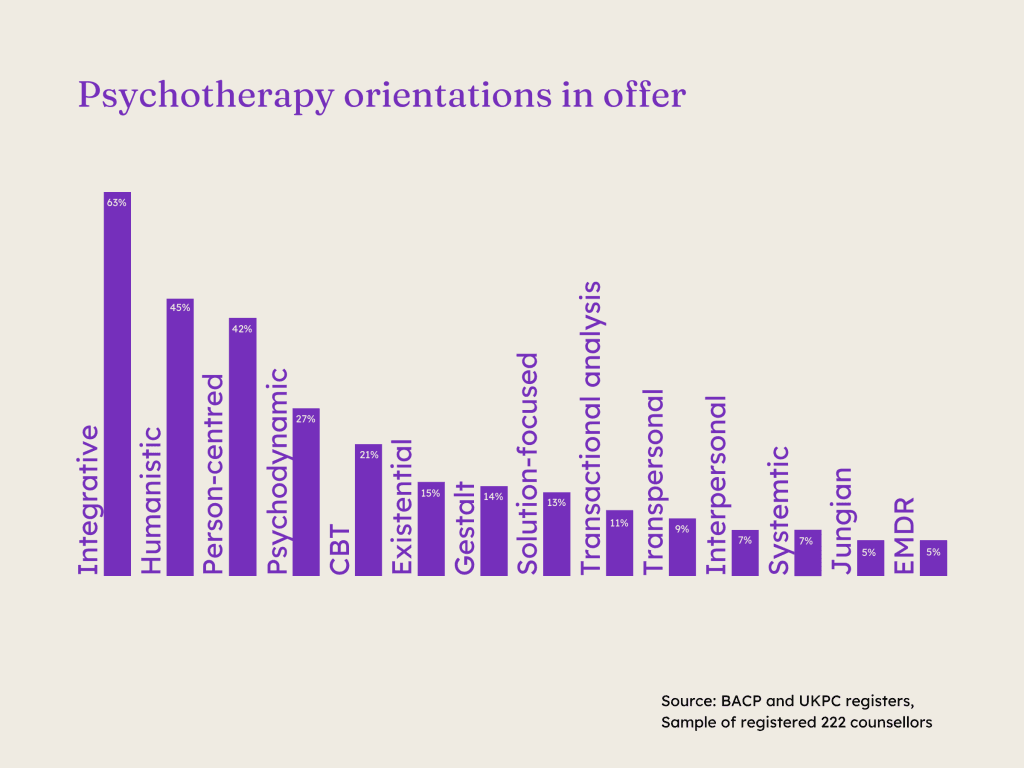
We reviewed the BACP and UKCP registers and took a sample of 222 UK counsellors to analyse their profiles and gather all the therapeutic orientations they offered.
Integrative – where a therapist draws from different approaches blending person-centred, cognitive and psychodynamic – is the most popular therapeutic approach.
This follows in perfect succession by the main schools of thought:
- Person-centred and humanistic
- Psychodynamic
- CBT
Integrative is the most popular therapeutic approach for BACP and UKCP sampled counsellors.
Some people (including myself) expected to see a large proportion of CBT therapists, as we know that’s by far the most popular in people’s minds (Google Trends). However, there is a lot of nuance to this, including the fact that we’re only sampling from private practice, and not the NHS. I plan to look into this topic a bit closer.
What’s the focus of different therapies?
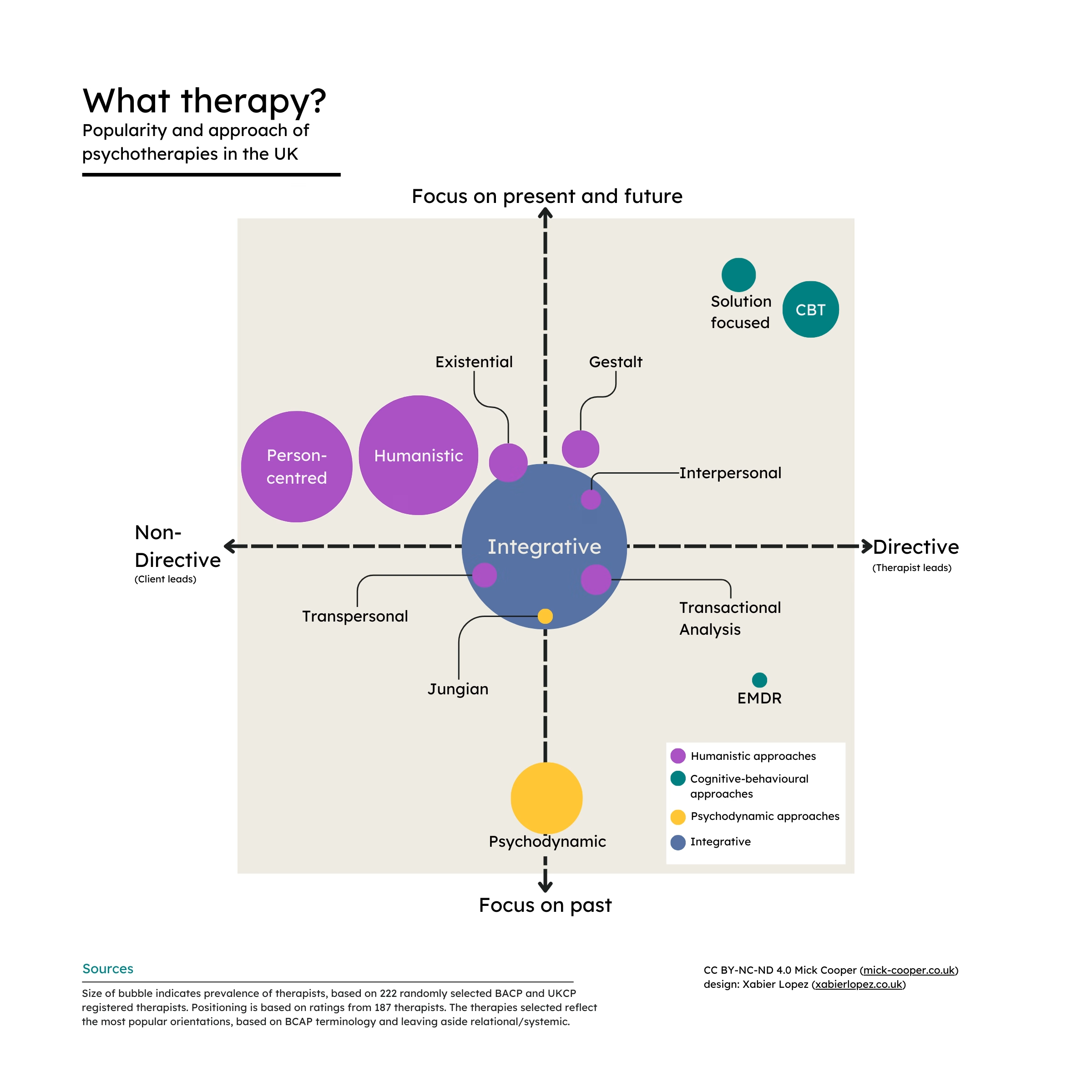
We picked two dimensions that we thought would meaningfully distinguish therapeutic orientations between themselves. Then, we distributed a survey and collected 187 responses from therapists to score each therapeutic orientation against these two dimensions.
Focus on the past vs focus on the present. This relates to its temporal dimension – is the therapist agenda towards understanding the past, or towards improving the future?
Directive vs non-directive. Is the therapist leading, or is the person?
Of course, the curse of quantitative research is that everything is simplified – when gathering feedback from colleagues in social media, Mick received many interesting comments. We found therapists in general understood EMDR as a directive orientation, however an EMDR-therapist made an argument that EMDR is not directive at all within its structure. The same happened with psychodynamic. The survey results put psychodynamic in the past, however psychodynamic therapists thought this lacked nuance.
At this point it’s important to say that we started this project to create a design for clients, not therapists – however mid-project we thought it would make interesting data for therapists too.