This is a journal entry, dealing with my own experiences, feelings and thoughts. Click here for psychotherapy theory, or here to find more about me.
—
To practice silence and be comfortable with it, I need to get to know it.
I got interested in silence as a counselling skill. And I quickly realised it’s something that used to make me uncomfortable (it still does).
Listening to silence can be a meditative practice in that we use “silence” as an object of attention and we really try to get to understand it. What does it sound like? What does it feel like? Does it have colour? Shape? What is it, actually?
Silence is a concept. It’s usually discussed in a relative way – as “lack of sound”. But this is a practical fallacy as even the lack of physical sound waves in a sensory deprivation chamber will still not lead a person to perceive a lack of sound, but rather deeper sounds within themselves.
I enjoy my practice of listening to silence and I have noticed there are three main ways in which I can work with it.
Relaxed silence
This is when I go somewhere very quiet such as an empty field, or at late times of the day in my flat.
In this scenario, silence is a series of background noises coming and going. Birdsong, road and air traffic, insects, wind and other natural sounds appear and disappear, revealing both familiarity and distinctiveness in each turn.
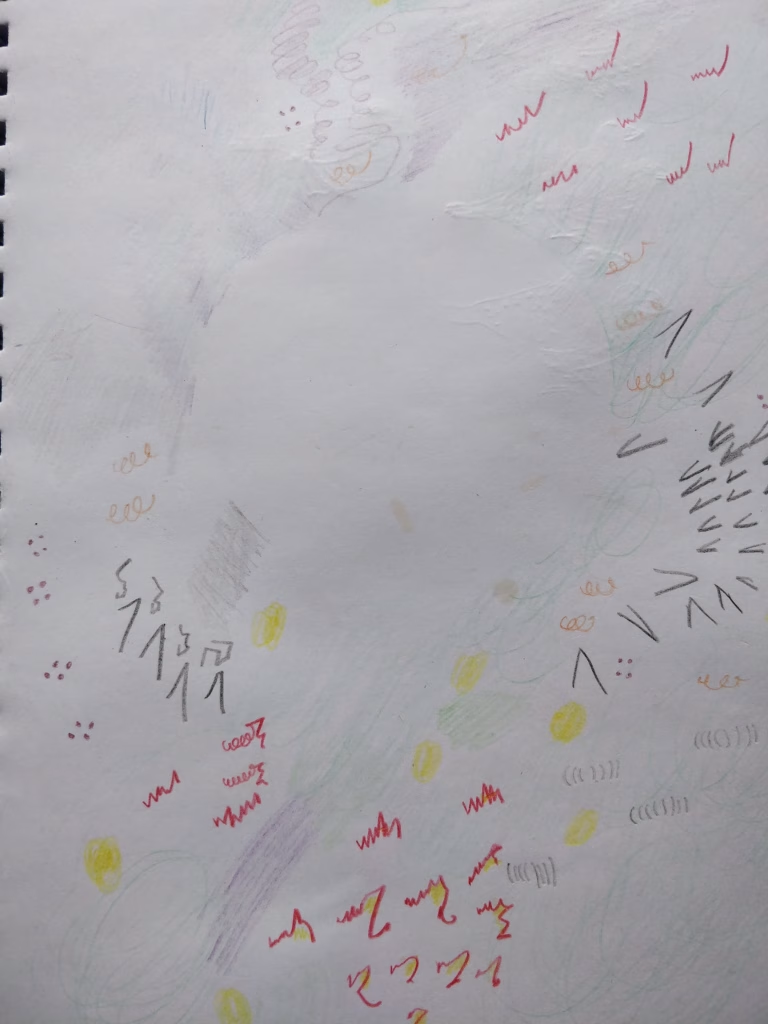
As I focus my full attention on one new sound at a time, I shape them in my mind. Then, I proceed to draw those sounds as they happen and mapping their location on paper to their coordinates.
Another layer of this experience is that, provided we can remain thoughtless for long enough, we can start sensing the silence in our own minds. And this for me creates a gap between me and the sounds I have become familiar with. On the contrary, if a thought takes my mind, the beautiful sounds that surrounded me before are now gone and instead there is a black cacophony of black and grey scribbles as the thoughts now leaving reveal little of interest has been gained. But that’s OK too, obviously.
Focused silence
This is when I put some earplugs and headphones and go to a quiet and dark spot in my flat. I can get very close to total external silence this way, with faint road sounds completely separate and isolated from a nothingness of an experience.
In a way, this quite resembles a concentration-based meditation in that all the focus is on the sound. But because there isn’t a typical sound to fall back on, it gets kind of weird.
Besides the breathing, I can hear my heart loud and clear. I see it fall in speed. I may also get a faint sense of a liquid sound, perhaps the blood flowing through my brain. Stomach and joints are occasional but loud.
Once everything from the body that I can hear has been identified and I can focus on and ignore at will, I get to the core of the silence.
And this sound – is made from my brains, clearly!
This can be pure tones or simple rythms resembling electronic music. By switching the attention between the heart and the aural hallucinations, the internal sounds get refreshed into new expressions.
It’s likely that the dopamine generated during this concentration can aid in visualising or experiencing synaesthesia. I like to allow shapes and colours illustrate the patterns and quality of these internal sounds, being careful not to get distracted from the sound as the main object of attention (rather than the visualisations).
Silence in dialog
Another type of silence, and most relevant to the counselling practice is the silence in dialog. This is a completely different type of silence, and one that we have been conditioned to avoid.
Silence in dialog tends to be a social faux pas, a sign of lack of chemistry. In a professional setting, it can make a client or customer concerned about the professional’s expertise.
In my marketing career, I was trained to contribute and convince. I was also trained to listen, but only as far as it would give me something better to say when my client stopped talking.
As I go through my counselling studies, I am developing a sensitivity to the minutiae of the feelings that emerge when the person in front of you stops talking. I am developing awareness of the panic that builds up within me.
The other day I had a wonderful chance to put it in practice. I was chatting to a friend and we were having an intense conversation about something that mostly affected them.
There was something that I said that I immediately thought “OK, that’s quite a lot to process if they heard that”. Because we were at home, I simply closed my eyes and went into my own world. I think we spent about 10 minutes in silence and I think they found that very helpful. It was a beautiful moment.