Much attention has been given to the arousal and expression of anger from clients in therapy (Lewis et al, 2008; Greenberg, 2015). Meanwhile, the therapists’ own experiences of anger are often considered taboo, unresolved personal issues or unproductive countertransference.
For example, Freud considered the relational aspect of the therapeutic work a matter of transference and countertransference, forms of resistance that impede treatment (Watkins, 1978). Carl Rogers cautioned about exiting the client’s internal frame of reference (1957). Cognitive-behavioural theory also places emphasis on the client’s cognitive and behavioural processes, advocating for expert-led and evidenced-based interventions that leave little room for the therapist’s own process.
In addition to the influence of such theoretical frameworks advocating for what Rowan and Jacobs termed the use of an instrumental self in therapy (2002), anger is strongly regulated in therapists by different layers of cultural processes.
In Anglosaxon cultures, people can experience quite a lot of anxiety and disapproval when they hear about others being angry (Greenberg, 2015). Each culture has its own display rules that regulate the expression of anger (Lewis et al, 2008). And in some families, anger may never have been allowed.
In addition to this, counsellors can have a self-idealised image of what a counsellor should be like and traditionally work on the assumption that our emotions will remain in the background (Berthoud and Noyer, 2021).
In this article, I will explore the expression of anger from the therapist as potentially productive (as well as destructive) for the process of therapy. In particular, I will explore the ethical considerations of unveiling our anger as therapists.
The expression of the therapist’s anger is an ethical dilemma: what should I do with this impatience, annoyance, frustration, anger once I have felt it within me as a result of the client’s words, actions, stories and ways of being in the world?
The expression of the therapist’s anger is an ethical dilemma
Will expressing these feelings of anger help my client? Will they reveal something about their interpersonal style as part of our co-created dynamic? Will this improve our relationship: more real, authentic and ultimately safe?
Or will my anger, when communicated, harm my client, damage the relationship, or erode their trust in me?

The centrality of the relationship
A key consideration in this ethical dilemma is the importance placed in the therapeutic relationship for the healing process of the client. If therapy is about an expert-led, evidence-based set of interventions, there is little room for the therapist’s emotional processes. However, as I will go on to argue now, authentic encounter is an essential attribute of the healing potential of the therapeutic process.
Rowan and Jacobs (2002) talk of three potential uses of self: instrumental (the therapists use their self as an objective instrument), authentic (the therapist uses their subjectivity in conjunction with their objective tooling) and transpersonal (the therapist goes beyond their subjectivity and consider the intersubjective space and the collective unconscious).
Whereas much of psychotherapeutic practice from the previous century has effectively advocated for an instrumental use of self, the humanistic paradigm has traditionally argued for the healing potential of authentic encounter between people (Buber, Gendlin, Levinas, Rank, Rogers, Yalom, Bugental) and has ushered an era where all schools of thought (psychodynamic, cognitive-behavioural, transpersonal as well as existential-humanistic) now place the relationship as fundamental in psychotherapeutic practice (Haugh and Paul, 2008). In fact, evidence regularly shows that the quality of the therapeutic alliance as well as other relationship factors predict good outcomes and account for as much as 15% of attributable change from therapy, above both therapist and technique factors. (Cooper, 2008, 2016)
Authentic encounter is an essential attribute of the healing potential of the therapeutic process.
Working from a relational lens calls for the authentic self of the therapist to enter the picture. And in fact, authenticity is one of the core conditions in person-centred therapy, which then poses the question: can I deliver the core conditions of change if I am not honest about my own feelings as a therapist? And if I do share my feelings and they are not positive, do I then endanger the delivery of positive regard, another core condition?) (Berthoud and Noyer, 2021)

The centrality of an authentic relationship (Buber, Rogers, Yalom), the potential of the use of the therapist’s person (Watkins, Aponte, 2021; Finlay 2022) and how appropriate self-disclosing enables a more authentic encounter (Alva et al, 2024) and delivers positive outcomes (Cooper, 2008, 2026) welcome the possibility of the expression of the therapist’s feelings as an ingredient of positive change.
Now, I will explore the potential consequences of anger in therapy more specifically.
The potential benefits and risks from expressing anger as a therapist
Anger is something people feel for a reason. Aristotles reflected that “only fools don’t get angry” and proposed that anger stems from an offence (quoted in Lewis et al. 2008)
Anger carries a message about boundaries being invaded, emotional hurt, and violation of personal rights. Anger mobilises the system to prevent this and help set boundaries (Greenberg, 2015). It also organises processes related to self-defence and mastery and provides energy to overcome obstacles in the way towards goals (Lewis et al. 2008)
However on the other hand, the expression of anger repels others (ibid), can be destructive, hurt others, produce misunderstandings, prevent listening and collaboration and often leads to escalating conflict (Greenberg, 2015)
In short, anger can be life sustaining, as well as destructive (ibid.)
I will now consider potential benefits from therapist expression of anger, assuming that this anger is constructively expressed and adequately assimilated by the client and the relationship, a topic I will expand in the last section.
Anger can be life sustaining, as well as destructive
Leslie S. Greenberg
Strengthening the therapeutic relationship
Safety in relationships is not produced by the absence of difficult feelings but by the successful navigation of them.
When the therapist shows anger, they expand the relational contracting, and allow the client to accept more of themselves too. Not only that, but this authentic approach can deepen trust too and led to a stronger relationship (Yalom, 1980)
Expression of anger will initially challenge the relationship, however provided it’s efficiently repaired or worked through, it will become stronger from this process. (Samstag, Muran)
Offering a corrective experience and practice of interpersonal skills
Therapy can provide “corrective” emotional transactions that open up new possibilities in relating to others outside of therapy (Greenberg, 2015).
Therefore, when a therapist allows anger to enter the room, clients get an opportunity to work with someone else’s anger in a safe, accepting and carefully co-constructed space – a “rehearsal for living” as Emmy van Deurzen would say (1997).
This therapeutic immediacy may help clients by providing more adaptive relational experiences to the ones they are used to and thus modelling strategies for interpersonal functioning (Blume-Marcovici, 2017).
Modelling mature and healthy functioning
Anger feelings are universal, but they are not always expressed. For clients who struggle to become aware or express their own anger effectively or at all, the therapist can model how to become responsible for our own feelings and how to show up authentically (Berthoud and Noyer, 2024).
Delivering “presence”
As Yalom argues, the client heals from the authentic encounter with the therapist. He argues that Freud’s theorised about neutrality but behaved in ways that showed commitment above and beyond the professional relationship (something that has inspired Yalom to show a wide scope of interventions) (Yalom, 1980)
When the therapist shows the anger they feel towards the client, they are demonstrating that they care about what’s happening. After all, anger is most often directed at loved ones (Greenberg, 2015).
In a perfect demonstration of this process, David Mearns shows his anger at this client who has come drunk to therapy. The problem is not that the client is drunk, but that they are wasting time, something that Mearns promptly reacts against.
- Client: Big question. Maybe I need another vodka before I can answer that
- Therapist: Dom, be here, be here drunk, but don’t play fucking games with me. Neither you nor I deserve that.
(Cooper and Mearns, 2005)

However, there are also risks.
Harm the client
Anger repels others (Lewis et al, 2008) and has the potential to re-traumatise clients who have experienced overwhelming or dangerous anger at times where they couldn’t cope with it (source?)
We don’t want therapy to repeat patterns from individuals histories of manipulation, violence or powerlessness (Finlay, 2022) and yet that is the potential that a burst of anger can have in the client.
Reinforce power in the therapeutic relationship
Gillian Proctor explains that therapists should aim to avoid using their “power-over” (Starhawk, French, quoted in Proctor, 2018) their clients and counterbalance the position of power with an ethical stance. Instead therapists are asked to tap into the sense of inner strength and “power-from-within” (Starhawk, quoted in Proctor) while facilitating that clients use theirs (2018).
Since expressed anger can intimidate the clients and further empower the therapist, it is an ethically charged dilemma that requires thoughtful consideration and ethical guardrails (see next section )
Distract from the client’s material
Finally, as a piece of self-disclosure, expression of anger can be unhelpful if it distracts attention from the client’s process and makes it difficult to resume it (Alva et al, 2024).
A framework for ethical use of the therapists’ angry feelings in therapy
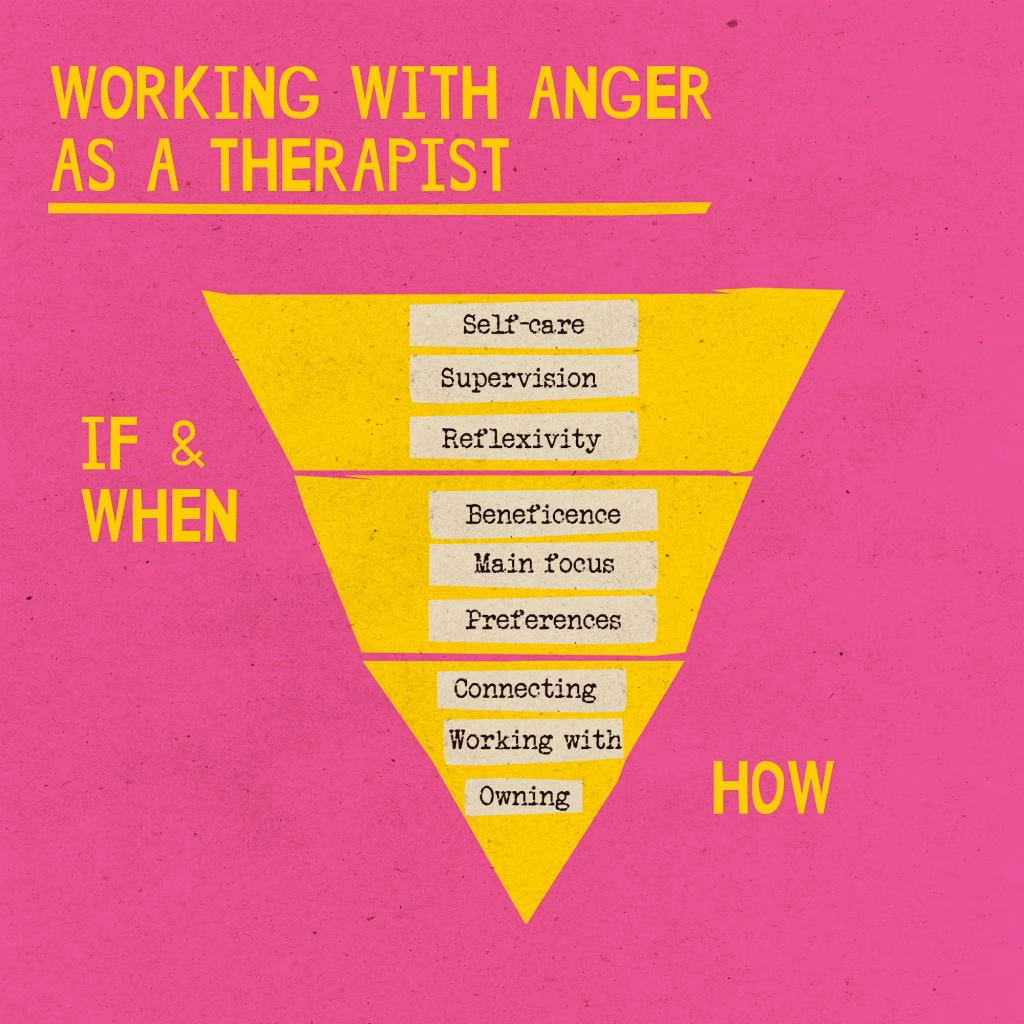
In order to achieve the potential benefits and minimise the risks, we need to draw on the ethics of counselling to determine the if, when and how of communicating this anger to the client.
Awareness of anger and expression of anger are two separate tasks requiring different types of skills (Greenberg, 2015).
Based on these two dimensions (awareness and expression), we can consider a quadrant of possible scenarios for the emergence of anger in the therapist (expanded from Berthoud and Noyer, 2021).
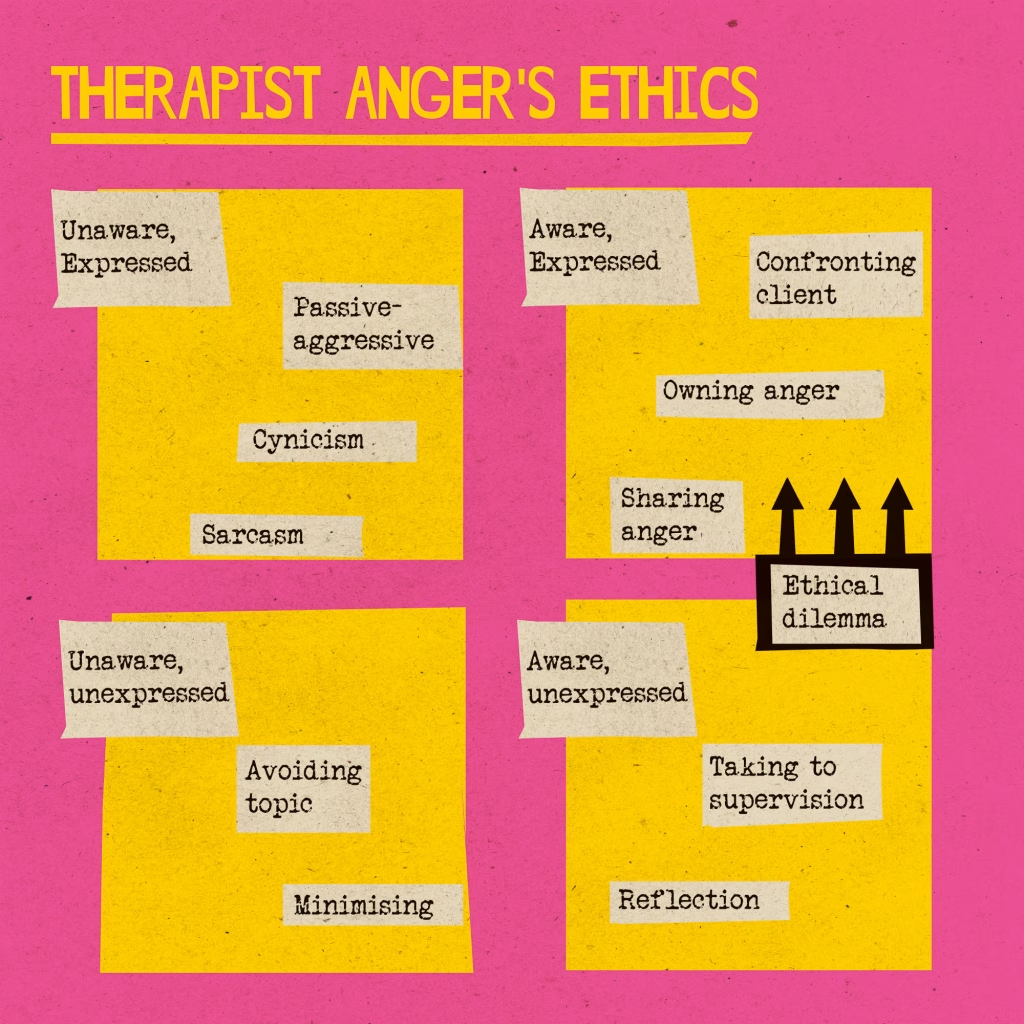
- Unaware, unexpressed. When the therapist is angry, yet they are not aware of it and they don’t express it. Example behaviours include minimising, avoiding or changing topic.
- Unaware, expressed. Even if the therapist isn’t aware of their own anger, they can still find ways to express it, such as passive-aggressive behaviour and misplacement.
- Aware, unexpressed. In this scenario, the therapist is aware of their angry feelings but they make a choice not to express it, either because they are unable to do it constructively (repression, lack of skills or confidence) or because they consider this expression wouldn’t help the client, the therapeutic relationship nor contribute to therapeutic outcomes.
- Aware, expressed. Finally, when the therapist is both aware of their anger and intentionally expresses it.
Using this quadrant as a starting point, we can consider the “dual task” set by Greenberg as a sequence of events:
- Developing awareness of anger as it emerges to give us better options as to how to work with it, avoiding unhealthy repression and unintentional hurtful communication (such as topic avoidance, minimisation or passive-aggressiveness)
- Having gained awareness of our own anger, make a decision as to if, when, and how to express our angry feelings in relation to our client. It’s important to note that both communicating our anger and not doing so can be equally valid, provided that decision has been made on ethical grounds.
The model I am proposing is intended to help therapists achieve these tasks in succession for the best possible outcomes. To do so, I am taking into account the BACP ethical framework, which guides the professional conduct and practice of counsellors and psychotherapists in the UK.
It is based on three areas focusing in turn on the therapist, the client and their relationship.
Therapist-focus: establishing a solid foundation for our practice
Considering the “use of self” (the authentic self in Rowan and Jacobs (2002)) as central to the therapeutic process (Yalom, 1980; Aponte, 2021 ; Finlay 2022) encourages counsellors to engage in self-care, seek support in supervision and develop personally through the use of reflexivity and their own personal therapy.
Anger can be caused by transgressions, but it can also happen for organic causes such as lack of sleep, stress, tiredness or burnout (Lewis et al. 2008; Greenberg, 2015). Ethically speaking, as therapists, we need to make sure we are “monitoring and maintaining our own psychological and physical health” and that we are “keeping a healthy balance between our work and other aspects of life” (BACP Ethical Framework, Good practice, 91).
In other words, we need to make sure that our state is healthy so that when feelings of anger arise we can take into account the contribution of organic causes unrelated to the client or the intersubjective space. We would think twice of expressing anger if we know we are tired, stressed or burnout and instead, consider a preliminary step of seeking supervision and reflect on what’s happened, our feelings and meanings.
Supervision is integral to good practice (BACP) and provides the ideal means by which practitioners can get an outside perspective and help to work through with ethical dilemmas, such as the ones posed by the emergence of angry feelings. Ideally therapists can engage the foresight to take feelings of anger to supervision to maintain sight of ethical and moral considerations.
Finally, reflexity is essential for practitioners to make decisions as to if, how and when to self-disclose angry feelings about clients by considering the needs and preferences of the client (next section) as well as the potential impact on the therapeutic relationship (last section)
Aponte’s Person of the Therapist Training model (2021) places self-awareness as a central skill in the usage of self to make sure therapists are aware of their “signature themes”, the current and core issues that may be enacted in the therapeutic relationship in detriment of the client or the working alliance (ibid). Making use of personal therapy to increase awareness of signature themes and personal material helps counsellors distinguish from where thoughts and feelings come from.
Client-focus: considering client’s needs and preferences
Having a professional practice guided by foundational principles of self-care, supervision and personal development provides a solid foundation for any therapeutic process.
In addition to this, we need to consider our fundamental client-orientation and relational ethics underpinning the humanistic paradigm. The BACP framework establishes that “We will make each client the primary focus of our attention and our work during our sessions together” and that “We will do everything we can to develop and protect our clients’ trust” (Good practice 9 and 12).
This means that, upon recognising feelings of anger arising in ourselves, we need to make a conscious choice based on a belief that revealing these feelings will be a net benefit to our client or the working relationship.
Yalom, a strong proponent of “use of self” and immediacy in therapy has given us many examples of times when he felt anger but decided it was not in the client’s interests to reveal that.
- “My negative feelings toward him were rapidly growing, but I kept them to myself”
- “She was sorely testing my patience”
(1988)
In addition to the therapist’s consideration of the client’s wellbeing and trust, we need to take into account that clients will have different preferences about the type of interaction they want to have with their therapist.
Research consistently shows the importance of adapting therapy to the individual (Norcross, 2011; Cooper 2026). Therefore, there is no magic formula by which a therapist can make a universal decision on how to work with their own feelings.
The Norcross-Cooper inventory of preferences C-NIP (2016) allows clients to express their preferences across dimensions such as “emotional intensity vs reserve” and “support vs challenge”. Therefore, therapists may use this tool to get a broad sense of their client preferences. Clients who score high on items such as “be confrontational” or “be challenging” may benefit more from addressed anger than clients who seek a “gentle” and “supporting” therapist.
Relationship-focus: Skillfully working with anger as it arises
Provided that the therapist feels that it would be healthy to communicate some of the anger they are feeling and that they have considered it potentially beneficial for the client’s process, there are decisions to be made as to when and how to communicate these feelings and how to skillfully work with the process that will unfold.
Owning our anger
Firstly, we need to own our anger as a feeling that has emerged within us. As Rogers said, “and I like to confront another person only feelings I am willing to claim as my own” (Rogers, 1970: 55 in Berthoud and Noyer, 2021).
Instead of saying ”you are wasting our time with your games”, we could say “I feel angry because I think you are playing games and I am worried this steals our chance of doing important work here”.
By owning our anger and expressing it as a feeling of ours, we effectively communicate some vulnerability and a willingness to dig into this anger and discover associated feelings (sadness, or worry) or thought processes (caring about the relationship’s productivity or therapeutic goals).
Directed towards words or behaviour rather than the client’s person
Good use of self in therapy demands that we accept our flawed humanity (Aponte, ), a key idea to support an empathic and positively regarding stance towards our client in the face
Therapists can struggle to resolve the tension between congruence (definition) and positive regard (definition), two of the core conditions in therapy which have shown demonstrable positive outcomes in therapy (Cooper, 2008, 2026).
In other words, if I show my anger, do I risk slipping my fundamentally positive regard for the client? And if I don’t show my anger, am I at risk of being incongruent?
As Berthoud and Noyer argued (2024) based on Roger’s seminal work, empathy does not mean identifying with the client and being congruous does not mean forcing one’s feelings onto the client. Directing anger at a behaviour rather than a person allows the therapist to remain congruent without withdrawing positive regard from the client as a whole.
Angry feelings aren’t – shouldn’t – be directed towards the client, but to the specific words or actions that awoke these feelings in ourselves. Our clients’ experiences will always be more varied than those specific instances.
Therefore, a promising use of angry feelings in therapy may be:
- I am hearing you speak and I am getting this feeling that you are not taking this as seriously as we usally do and I am experiencing some frustration.
Not distracting from the client’s focus
Self-disclosure is most effective when it has a clear purpose, fits the client situation and maintains important boundaries (Alva et al). In contrast, self-disclosure is counter-productive when it takes away from the client’s focus, centres it on the therapist and makes it hard to re-focus on the client’s concerns.
Working with its immediacy
Angry feelings from the therapist should be based on the here-and-now experiencing (see point 1 on self-awareness) and therefore should be worked on with immediacy,
Staying connected
Expressing angry feelings may make it difficult for the therapeutic dyad to stay in contact (Berthoud), however it is crucial that the therapists models a relationship in which anger is allowed and ready to be operationalised.
This makes it possible for new patterns of relating to emerge with the training of new adaptive behaviours and interpersonal strategies in the context of conflict (Finlay, 2022)

In conclusion, feelings of anger are universal, adaptive and potentially helpful for the client’s healing process, however they can also be risky, destructive and harmful for the relationship.
Therefore, we need to bring a lot of thought and skill into considering if, how and when to express these feelings to our client in the hope of developing a stronger, more authentic relationship with our clients, congruence between different parts of ourselves and a model for addressing anger constructively.
Finally, an ethical framework has been suggested to address in turn the therapist, the client and the relational work with anger to minimise the potential for irreversible rupture while enabling authentic encounter.
The problem of the therapist anger is ethically charged and careful consideration needs to apply before the therapist decides to express their anger. However in those cases where the anger is skillfully managed for its potential for authentic encounter and presence it can lead to relational depth (Mearns and Cooper, 2005), and therefore ultimately healing for the client.
Bibliography
Alva MH, Antony SP, Kataria K. (2025) Exploring the Use of the Therapist’s Self in Therapy: A Systematic Review. Indian J Psychol Med. 47(1):17-24.
Aponte, H. J. (2022). The soul of therapy: The therapist’s use of self in the therapeutic relationship. Contemporary Family Therapy: An International Journal, 44(2), 136–143.
BACP (2018) Ethical Framework for the Counselling Professions. Lutterworth: BACP.
Berthoud, L. and Noyer, T. (2021) ‘Therapist anger: from being a therapeutic barrier to becoming a resource in the development of congruence’, Person-Centered & Experiential Psychotherapies, 20(1), pp. 34–47.
Blume-Marcovici, A. (2017) When therapists cry: Reflections on therapists’ tears in therapy.
Buber, M. (1970) I and Thou. New York: Scribner.
Cooper, M. (2008, 2016) Essential Research Findings in Counselling and Psychotherapy. London: SAGE Publications.
Cooper, M. and Mearns, D. (2005) Relational Depth in Counselling and Psychotherapy. London: SAGE Publications.
Finlay, L. (2022) The therapeutic use of self in counselling and psychotherapy, London: SAGE Publications.
Greenberg, L.S. (2015) Emotion-Focused Therapy: Coaching Clients to Work Through Their Feelings. 2nd edn. Washington DC: American Psychological Association.
Haugh, S. and Paul, S. (eds.) (2008) The Therapeutic Relationship: Perspectives and Themes. Ross-on-Wye: PCCS Books.
Lewis, M. et al. (2008) Handbook of Emotions. 3rd edn. New York: Guilford Press.
Linehan, M.M. (2015) DBT Skills Training Manual. 2nd edn. New York: Guilford Press.
Muran JC, Eubanks CF, Samstag LW. (2021) One more time with less jargon: An introduction to “Rupture Repair in Practice”. J Clin Psychol.;77:361–368
Norcross, J.C. and Cooper, M. (2021) Personalizing Psychotherapy: Assessing and Accommodating Patient Preferences. Washington DC: American Psychological Association..
Proctor, G. (2018) The Dynamics of Power in Counselling and Psychotherapy. 2nd edn. Ross-on-Wye: PCCS Books.
Rogers, C.R. (1957) ‘The necessary and sufficient conditions of therapeutic personality change’, Journal of Consulting Psychology, 21(2), pp.95–103.
Rogers, C.R. (1970) Carl Rogers on Encounter Groups. New York: Harper and Row.
Rowan, J. and Jacobs, M. (2002) The Therapist’s Use of Self. Buckingham: Open University Press.
Van Deurzen, E. (1997) Everyday Mysteries: Existential Dimensions of Psychotherapy. London: Routledge.
Watkins, C.E. (1978) Therapeutic Self: Developing Resonance, Key to Effective Relationships. Human Sciences Press, U.S.
Yalom, I.D. (1980) Existential Psychotherapy. New York: Basic Books.
Yalom, I.D. (1988) Love’s Executioner and Other Tales of Psychotherapy. New York: Basic Books.