“Everyone carries their parents inside…also a little boy/girl”
Eric Berne
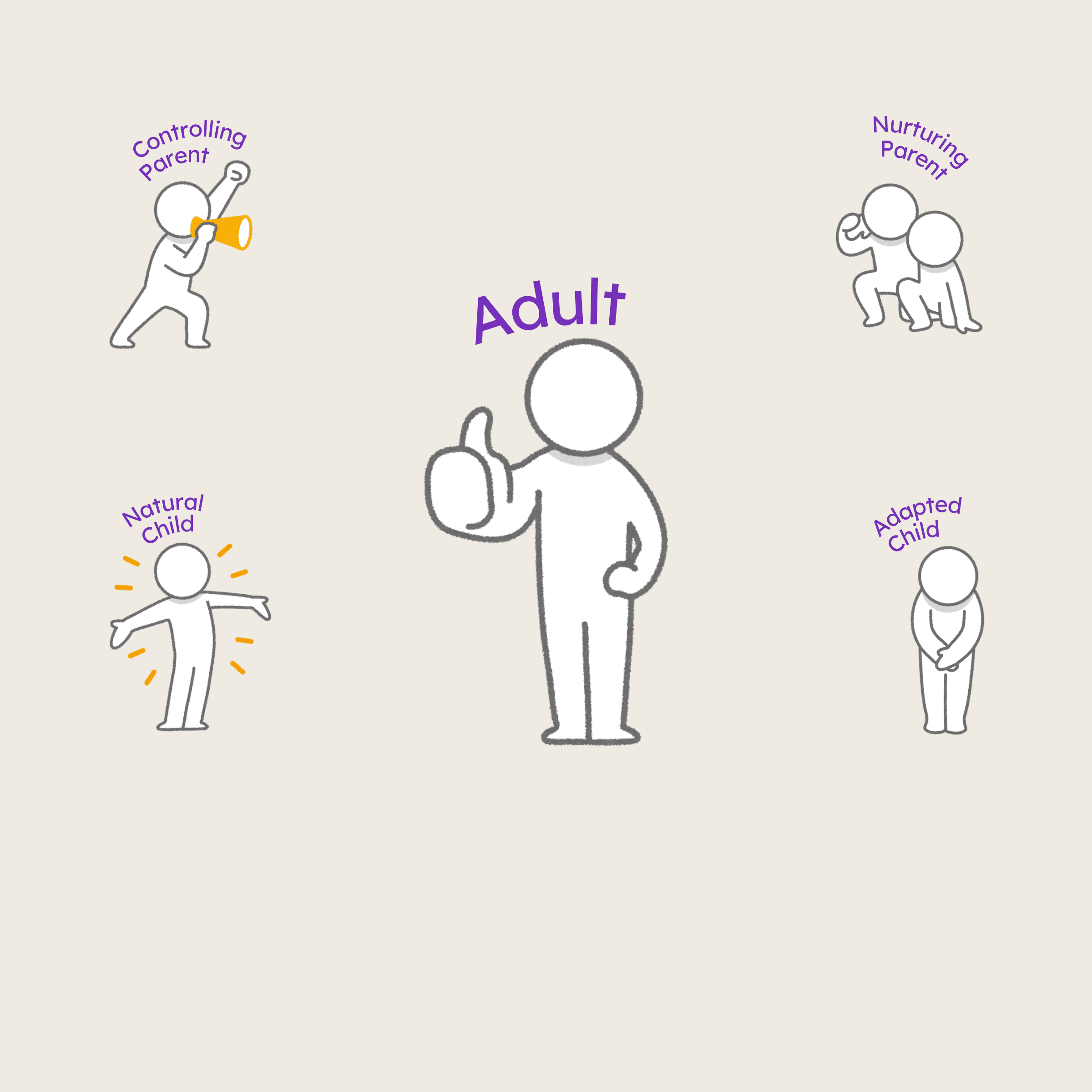
This article, and the diagrams are based on Games people play, by Eric Berne. It focuses on the internal dynamics between these different ego estates within the individual, almost as a prototype to Internal Family Systems.
Ego states – as conceptualised by Eric Berne – are psychological realities or modes of being that receive differing energy depending on the situation and our own tendencies.
They are systems of feelings coupled with a related set of behaviours and attitudes.
For example, three people may go past rubbish on the beach and show different ego states:
- “People are so dirty”, (so I will do nothing)
- “I like our beach to be clean” (so I will pick it up)
- “I should write a letter to my MP” (so I will do that)
Or, if fired from a job:
- “They are a bunch of morons” (so I will be really angry and “show them”)
- “I need to figure out my next move” (so I will go to a cafe to think with a notebook)
- “It always happens to me, what’s the point of trying” (so I will go to bed with ice cream)
Parent, Adult and Child ego states
There are three main ego states, each with a vital function to play.
Parent
These ego states are inherited from our parents and they lead to us displaying the feelings, attitudes, beliefs, vocabulary and/or posture that we learnt from them.
The main function of these estates – when in healthy display – is to protect our children or other non-adult dependents.
The Parent is further divided into:
- Controlling parent: critical, judgemental and controlling. Dominated by fear, the controlling parent is the harsh voice on ourselves and others. Associated with masculine energy and with achievement and discipline.
- Nurturing parent: caring, supportive and protective. This parent “just wants to help others”. In the right dose, the nurturing parent is very positive, unless it errs towards “rescuing”, self-effacing, clinginess and lack of accountability and contribution.
Adult
In this ego state, we assess reality with objectivity and are capable of making the best decisions based on an appraisal of the situation. It’s easy to interpret (and some people do) that the Adult is emotionless, however as Berne indicates it also plays the role of “regulating the activities of Parent and Child and mediating between them”, hinting at emotional regulation.
I personally agree with transactional analysts that argue the Adult as the ideal ego state precisely because in a healthy, uncontaminated version of this estate we are in touch with our real emotions and needs and can include those in our decision-making.
Child
These ego states were fixated in early childhood. At its best, the Child brings intuition, creativity, enjoyment of life and spontaneous drive.
The Child is further divided into:
- Natural Child: creative, intuitive and curious. This is our “original estate”, which we lose touch with as we adapt to societal and parental demands. Children who have experienced adverse conditions growing up may have completely lost touch with this child, or conversely, remain stuck in it.
- Adapted Child: obedient, pseudo-rebellious and structure-seeking. This is the child that has understood that parents and society put conditions of worth onto us to be accepted.
Internal conflicts between different ego states.
Transactional analysis is primarily concerned with the way people relate to each other and how these different estates are activated by one person in another one during social interactions.
For example, a boss exhibiting a Controlling Parent is likely to activate an Adapted Children. This interaction is not ideal, as companies benefit when employees use their creativity, intuition and joy, rather than thoughtless submission.
The employee, faced with a Controlling Parent can however notice this and make an effort to break the game by tuning into an Adult estate where the boss is listened to, but not necessarily agreed with or appeased. The Controlling Parent can’t parent someone on an Adult estate, so they will be forced to tune into their own Adult, or leave the scene.
However, conflict between estates can happen inside of us too.
Everyone carries at least a little of each of these five ego estates.
If these estates are balanced, well guided by the Adult and appropriately activated based on the demands of a situation, the individual will be well adapted.

Ego estate contamination
The Adult needs to be in charge. Yes, we can find value in small pockets of Parent and Child estates, however the individual will be at its best when the Adult can ensure the energy in each state is well distributed and activated appropriately based on context.
When the Adult starts allowing unnoticed and unfounded Parent beliefs or Child distortions, the everyday functioning of the Adult breaks down: the person can’t make decisions effectively, or they feel alienated and unable to relate to others.
This is contamination.

A Parent contamination occurs when the fears, insecurities and anxieties of our Controlling Parent (as taken from our own parents) distorts our ability to make life decisions as an Adult.
We may have objectively assessed the situation only then to “feel stuck” with an irrational fear of failing or “not fulfilling our potential” – an obvious Controlling Parent mantra.
Or keep going in circles as the Controlling Parent also activates our Adapted Child, who is also scared of the same things the Controlling Parent is: to make a mistake, to be shown as not worthy, to feel any of the learned feelings we get from adapting to our parents and society: guilt, shame, embarrassment.
A Child contamination occurs when beliefs and attitudes that were fixed in childhood distort the normal functioning of the Adult affecting work, life admin and relationships.
For example, a Child may distrust authority and in doing so misunderstand their true power. This distorts the Adult functioning and leads to self-sabotage in the real world (“I will quit before they make me”, “I will never be good enough”, “I will prove them wrong”).
A Parent contamination may show up as anxiety, whereas a Child contamination may show up as depression. Either may show up as anger.
Double contaminations are common since excessive Parent estates lead to excessive Child estates in turn and both weaken the Adult.
Distributing the energy between estates
Someone with no children or dependents has little use for Parent estates, especially of the Controlling kind. However someone with various children of their own and/or in control of many children (eg, a teacher) may find more use in lending energy to the Controlling Parent who can be excellent at showing people how to survive in society, as well as Nurturing Parent, who imbues confidence in people.
An artist, an innovator, a creative – may great joy in distributing energy to the Natural Child who is wild, fun, inventive and charming. As long as they can be an Adult when doing tax returns, and a well balanced Parent dealing with their own children. Once we understand the patterns and the roles of each estate, we can essentially take a measure of each of them and start understanding where we’d like to dial up or down.
We want to develop self-awareness and notice these ego estates as they intensify in situations. We can particularly watch for interactions – moments where the Child and the Parent argue with each other.
If we notice this – we have compassion. And we keep watching.
Who’s helping us feel good about ourselves? Who’s making sure we have a good life? Who’s attracting and keeping those around us safe and happy?
We say “thank you” when we notice our estates to be balanced, we have compassion when we see the opposite.
This makes our Adult strong and our Parent and Child happy to be taken care of.