…and attempt to spell out the picture of the person that would emerge if therapy were maximally successful. I was somewhat frightened by the fluid, relativistic, individualistic person that seemed to be the logical outcome of the process of therapy.
Carl Rogers, On becoming a person.
Ask people what they think makes for a good life and you will find many different answers.
Some people will relate to achievements, possessions and other goal-led end-states. Others may become more philosophical: “to be happy”, “to be free of worries”. Very rarely, if ever, the good life will be what it’s happening right now.
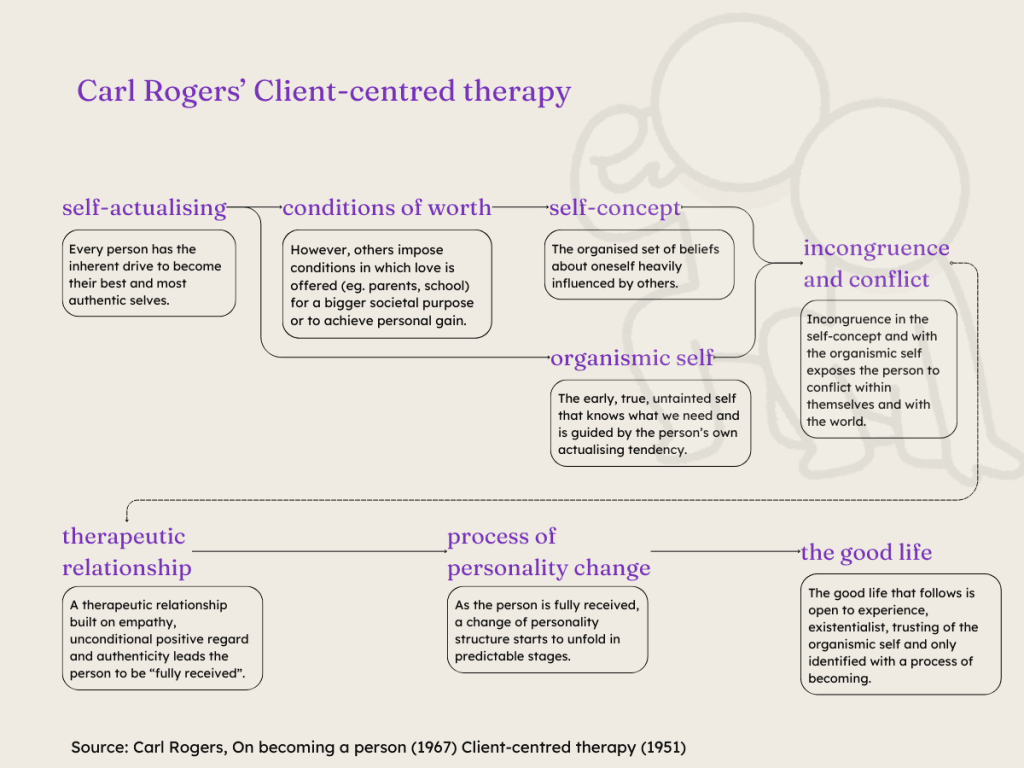
For Carl Rogers, a good life is what we experience when we combine our self-actualising tendency as humans with enough acceptance from the world (crucially from our parents, as well as other meaningful relationships along the way).
It’s a life that is open, adaptive and trusting.
What happens when we don’t receive acceptance
If we didn’t receive enough acceptance growing up, but rather were burdened with conditions of worth (as well as perhaps neglect, abuse, manipulation and other forms of non-acceptance) we will not be connected with our true selves, but rather operate from an unstable self-concept determined by an external locus of evaluation – ie, what others think of us.
We will be what we think that others think of us, in conflict with what we think they should think – and that bundle of conflict, will be, in turn, in conflict with our vaguely sensed authentic self.
This is no way to be.
It exposes us to breakdown when life events don’t follow the random guidelines of our house-of-cards personality structure. And even without breakdown, we will have a negative experience of life through anxiety, depression, jealousy, fear, paranoia, addiction and other negative feelings.
This, unfortunately, is quite normal. But it doesn’t need to be this way.
The therapeutic relationship as a key change agent
The next best chance for the good life is to develop self-acceptance and close the gap between the self-concept and the true self in the therapeutic relationship. This is only if the therapist can use their skills to provide the core conditions of unconditional positive regard, empathy and authenticity (or congruence, in Rogers’ definition).
When the person is “fully received” in this way, they can initiate a process of self-discovery where incongruences are noticed and addressed, feelings are felt and the experiencing of life changes in its quality.
As the process reaches its further stages we get into “the good life”.
The good life – but, is it?
Carl Rogers’ wrote about the good life whilst at the same time expressing concern that his evolving understanding of it was at odds with prevalent schools of thought.
For example, mental models in social and natural sciences focus on the absence of tension or disease and a consequent achievement of stasis or equilibrium.
For Rogers’ however, the tendency, the primal need of the individual is not towards harmony nor the absence of objective disease but towards the “the self as a reflexive awareness of experience” – in other words, to go with the flow.
Kali is shown chopping human heads off as a symbol to avoid identifying ourselves with our decaying bodies and instead embrace reality as the ongoing passing of time. Quite Rogerian.
To be where you are, to be what you are, in a constant sequence of each-moment-is-new, no-same-river-twice processes of mystical quality. If we become attached to a fixed moment of reality rather than its non-stop movement – we need to chop our heads off, figuratively.
Rogers said that whatever the client’s objectives were at the beginning of the relationship, they will change as the person learns from what’s happening inside of them.
It’s probably true that clients wouldn’t like the sound of this life before they experience it unfolding inside.
To be someone that could change their minds about important stuff?
To be someone who doesn’t really “believe in anything”?
To be someone not too bothered about goals and achievements?
But since we don’t need to know where we’re going to get there (because of our inherent tendency to grow and become at one with ourselves) we can just trust the process, fittingly.
Overview of Carl Rogers’ therapeutic approach
We can understand the good life as the final element in the overarching theoretical framework of Carl Rogers’ client-centred therapy.
One could argue that the good life is quite simply the experiencing of stage 6 and 7 of personality structure change, since it’s not meant to be an static destination but rather a universal direction of a human who is in process of being fully accepted.
This is instead something that happens and keeps happening: its process quality is fundamental.
It doesn’t change the person, it makes them, transforms them into change itself.
It is hard not to see paralells (and differences) with yogic moksha, or Buddhist nirvana. But that would be its own, complex post.
The good life is composed of three interconnected processes uniting perception, behaviour and inner experience.
Opening to experience life as it is
As the person integrates all aspects of themselves, there is a capacity to feel all the feelings and be open to that experience – of life in its full reality. There is no fear to keep becoming. There are no “problems”, but rather life is experienced with acceptance and compassion.
Trusting the organism to lead the way from the present moment.
The person now has developed a trustworthy inner voice that is able to assess situations more realistically, make better choices and “feel right” about them whichever way it goes.
Emerging as a self from experience.
The person now lives fully in each moment and therefore emerges as a self from their experience. Therefore, they don’t know what they will do, really, until they do it. They are not concerned about how they come across or even “who they are” to others.