The Apollonian and the Dionysian are two competing but complementary impulses that Nietzsche proposed and developed throughout his lifetime.
In this article, I want to explore these two impulses in both their contradictory and complementary roles, how they may be appearing in our lives and how we could reflect on them as tools of self-knowledge and development.
What are the Apollonian and Dionysian drives?
Nietzsche defined the Apollonian and Dionysian as both “a duality” and as two separate “drives” (Trieb) that “run in parallel with each other, for the most part diverging openly and continually stimulating each other to ever new and more powerful births”.
We can think of each of them as unconscious ways of being, relating and as inclinations towards certain attitudes and behaviours.
The inspiration comes from the Greek pantheon.
- Apollo is the god of beauty, light, healing, medicine.
- Dionysus is the god of wine, festivities, religious ecstasy and madness.
Apollo and the Apollonian drive
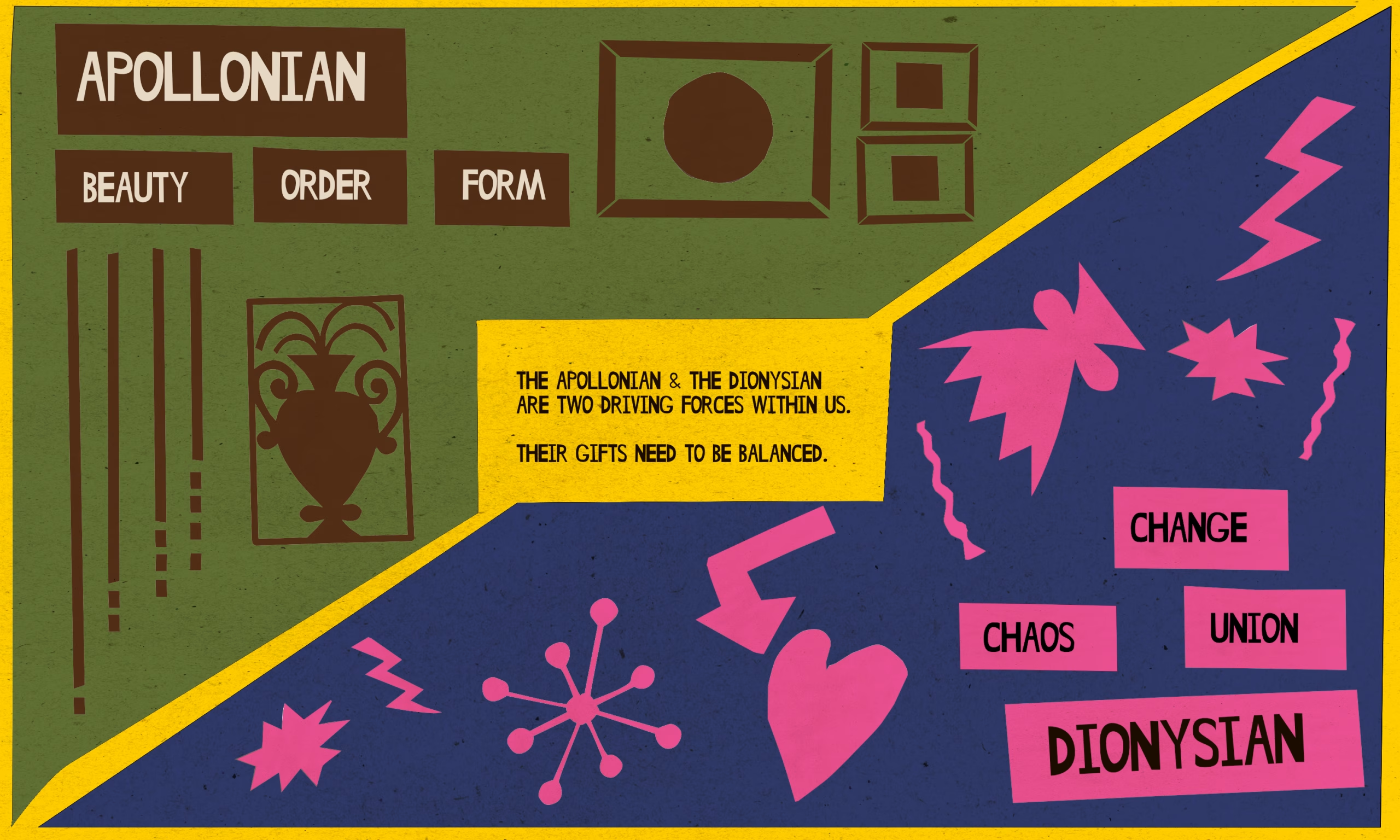
In Nietzsche’s work, the Apollonian ways of being are moderation, rational knowledge and serenity. In relating to others the Apollonian is individualistic, even if moral.
The Apollonian’s method is dreaming: imagining goals, then disciplining oneself to attain them.
The Apollonian ways of being are moderation, rational knowledge and serenity
Existentially, the Apollonian may be seeking a “warm narrowness that keeps away fear and encloses one in optimistic horizons”. Keeping busy to avoid life’s ultimate concerns: death, aloneness and the burden of choice.
The potential underlying malaise in the Apollonian is an impoverishment of life. Unenamoured with life, it dreams on and works hard trying to achieve a state that never comes – for life is a process of becoming.
The risk in the Apollonian drive is oppression towards others: a desire to “turn what is most personal (…) into a binding law and compulsion – one, who as it were, revenges himself on all things by forcing his own image, the image of his torture, on them, branding them with it.”
Some examples of people with an Apollonian excess may be:
- The authoritative parent who pushes his/her children towards achieving their own dreams.
- The moralist who insists others conform to their worldview.
- The over-achiever who struggles to relate to others through a superiority complex.
- The passionate workaholic with no sense of community or belonging
- The lone artist who struggles to work with others.
However, when channeled in balance, it achieves
- Calm, safety.
- Gratitude and love.
- Creation, building, posteriority.
- Resources, achievements.
Dionysus and the Dionysian
By contrast the Dionysian ways of being are chaotic, spontaneous, seeking of change and immediacy. In relating to others, the Dyonisian favours losing itself in community or mystic union.
The Dyonisian’s method is intoxication. It seeks to connect with the underlying truth of human experience, to be in the here-and-now, confident in whatever the future may bring.
The Dionysian ways of being are chaotic, spontaneous, seeking of change and immediacy
The potential underlying malaise in the Dyonisian is an over-fullness of life. To be overwhelmed with a formless existence lived in the present moment.
The risk of the Dyonisian life is destruction and self-destruction, outraged by anything that exists. Obsessed with change and becoming, the Dyonisian impulse may reject form and function: resources, wealth, property, plans, goals.
Some examples of people with a Dyonisian excess may be:
- The chaotic parent who neglect his/her children
- The radicalised activist who vandalise property to release a misplaced anger
- The under-achiever struggling to think of goals, let alone achieve them
- The apathetic drug and alcohol abusers with ever narrowing possibilities
- The mystic who has renounced all life in the name of mystical union.
However, when channeled in balance, it achieves
- Joy, vitality.
- Belonging.
- Intuition, spiritual development.
- Resourcefulness in changing, adapting, becoming and overcoming.
Holding the complementary forces in the Apollonian and Dionysian
There isn’t a magical recipe on how to mix these two drives. They are simply forces within us that may emerge at different times. We can observe them and understand the ways in which they come up for us.
For example: am I being too Apollonian right now?
The beauty in this idea is to lend as a language to feel and codify what may be happening within us.
Perhaps we have been brought up in an Apollonian culture and we feel something is missing, a certain joy: that something missing could be a little Dionysian shake up.
How we bring that in is down to us: perhaps dance, movement or adventure may resonate with us. Maybe breaking something, swimming naked in the sea at night, talking to strangers, getting lost in a new city, doing something new that we really like the idea of but feel scared about, or eating more than is healthy. Something to get us intoxicated with the feeling of being alive – or just quite simply, intoxicated. Something that gets us closer to community or even mystical union: a gig, a weekend festival or a psychedelic retreat.
And what if we are on the side of the problem? Full of life and a little overwhelmed by it. We can never find our wallet, remember our passwords or save enough money to buy our own property.
Again, we can be creative in how we bring the Apollonian: learning a new hobby, starting some rituals, signing up to the gym, getting some help, opening a spreadsheet, making a list. We can use our imagination to dream a better life, rejoice in the fantasy, then make the steps necessary to get closer to it.
We can also explore our gratefulness for the resources in our life: the roof above our heads, the electricity around us or the water flowing from our taps. We can use that appreciation to welcome the Apollonian that wants the things that will allow “rest, stillness, calm seas”.
This idea lends as a language to feel and codify what may be happening within us
There’s no solution to the conflict
Ultimately, we never fully resolve the conflict. Our context changes and we change with it, and the right balance of these forces keeps shifting. What one day brought us energy or gave us structure no longer does it..
We need to keep asking ourselves questions, then exploring and experimenting with the help of our companion spirits: the Apollonian and the Dionysian.
Some questions to get started:
- Am I experiencing a life on the Apollonian or the Dionysian side? Or are they in balance?
- If one dominates, do I suffer from some of its risks? Am I missing something?
- If I am short on either impulse, what activities may allow me to explore it in a way that still feels authentic for me?
Bibliography
Nietzsche, F., 2000. The Birth of Tragedy. Translated, introduced and annotated by D. Smith. Oxford: Oxford University Press.
Nietzsche, F., 1974. The Gay Science. Translated, with commentary, by W. Kaufmann. New York: Vintage.