Category: Psychotherapy
How School-Based Counselling Helps
I worked with Mick Cooper to design a poster to promote his latest piece of research. It shows the ways in which school based humanistic counselling helps young people. I found interesting that “advice” was an important process of change – if you read the paper you will also find out what aspects of the…
Having vs being as modes of existence
in HumanisticErich Fromm was a humanist philosopher and psychoanalyst associated with critical theory. He blended the analysis of social and psychological factors to explore different philosophies of living. In To Have or To Be?, he examines two broad perspectives on life. — He explored how spiritual and cultural traditions have intertwined with structures of power to…

Games people play: A classified list of Eric Berne’s games in Transactional Analysis
This article brings together two frameworks from Transactional Analysis: “Games” from Eric Berne (Games people play) and “The Drama Triangle” from Stephen Karpman. – Our thoughts and behaviours are often guided by unconscious scripts we’re following – whether it takes us a minute to realise, or years. Uncovering those scripts – and in the process…

What type of psychotherapy orientation is best for what?
This article is based on the Mick Cooper’s “Essential Research Findings in Counselling and Psychotherapy, Facts are Friendly” book compiling studies of effectiveness in counselling and psychotherapy. It is a great reference book and I am leaving most data behind (so that you buy the book, which is fantastic). What therapy is most effective for…
An informal study of Psychotherapeutic orientations
I worked with Psychotherapeutic author Mick Cooper to do an informal study of psychotherapeutic orientations in the UK. Psychotherapy is complex. When someone decides that they would like / need some therapy, they may or may not have some ideas of the type of therapist they need. Some people may consider their particular known issue,…
Karen Horney’s theory of personality
The below is taken from Neurosis and Growth (Karen Horney, 1951), as well as summaries and commentaries from here and here and occassionaly my own reflections along the way. – Karen Horney was an amazing woman. She immensely respected Freud but challenged much of psychoanalytical orthodoxy. She provided a theoretical framework of mental illness that…
Guide to counselling skills
Counselling skills are a cluster of learned and practised abilities that therapists use with clients to achieve the goals of therapy. Developing these skills involves a combination of knowledge, practice, reflection and feedback. Listening Listening is a core counselling skill – it’s also frustratingly hard. Growing up we’re told to control the narrative and dominate…
The regulation of Parent, Child and Adult ego states
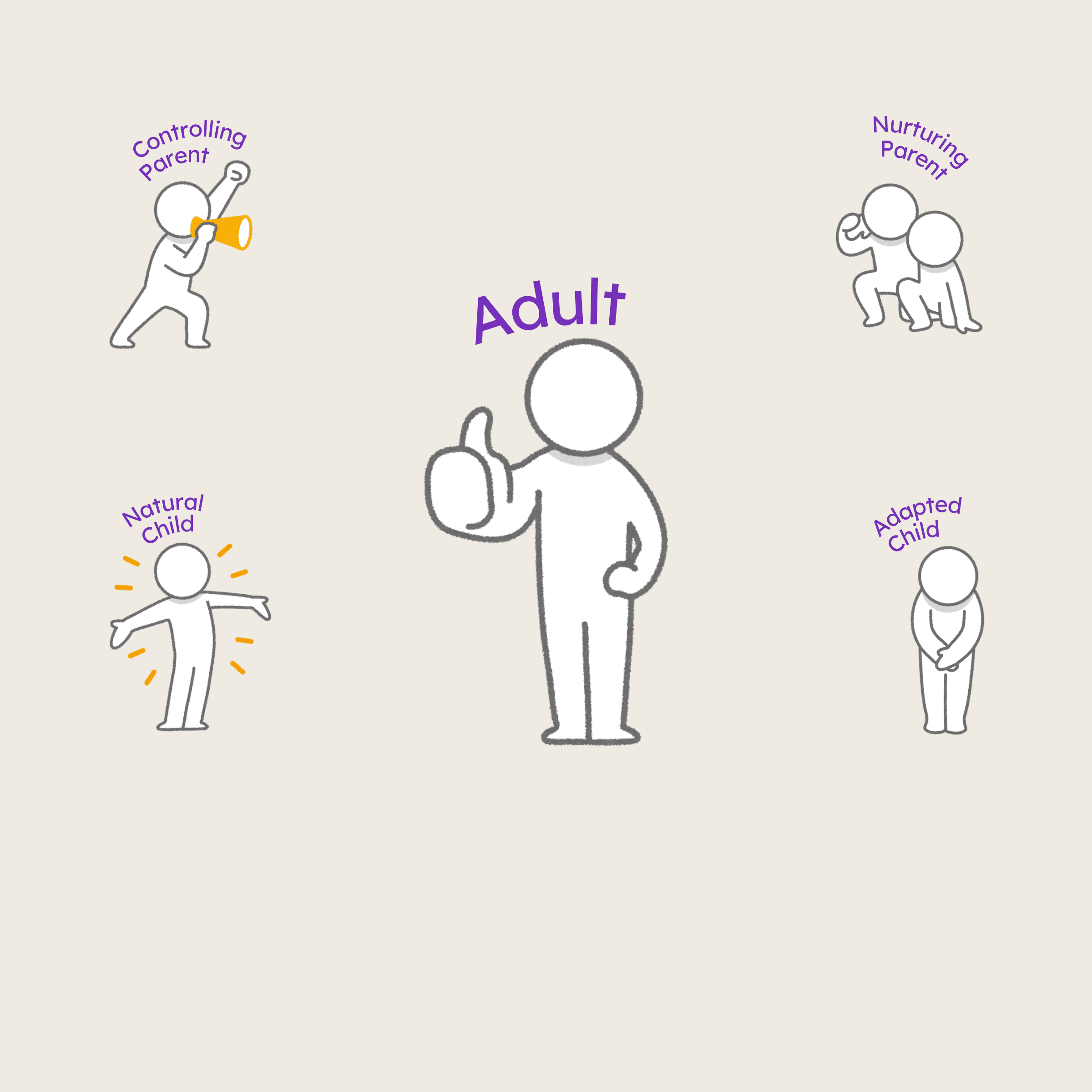
“Everyone carries their parents inside…also a little boy/girl” Eric Berne This article, and the diagrams are based on Games people play, by Eric Berne. It focuses on the internal dynamics between these different ego estates within the individual, almost as a prototype to Internal Family Systems. Ego states – as conceptualised by Eric Berne –…
The Good Life (according to Carl Rogers)
Ask people what they think makes for a good life and you will find many different answers. Some people will relate to achievements, possessions and other goal-led end-states. Others may become more philosophical: “to be happy”, “to be free of worries”. Very rarely, if ever, the good life will be what it’s happening right now. …
The seven stages of the counselling process according to Rogers
It did not appeal to me to review work we have done in the past. I decided rather to devote a year (…) to understand the process by which personality changes (…) but as the next year approached I realised the ideas I had formed were still unclear, tentative, hardly in the shape of a…