Carl Jung was a psychiatrist, psychotherapist and psychologist who studied with Freud until their theoretical differences brought them apart.
Jung went on to develop a unique school within psychoanalysis based on his model of the self and the methodology to work within it: a framework of symbols, dreamwork, dialogue, active imagination, and inner exploration.
To do this, he studied not only philosophy but also anthropology, mythology and comparative religion. This combination has resulted in a unique proposition that appeals to both psychodynamic and humanistic psychotherapists, as well as across a wide range of other disciplines and human endeavours.
In this article I’d like to give an overview of this model of the self as a reference for exploration of Jungian psychology.
The structure of the psyche
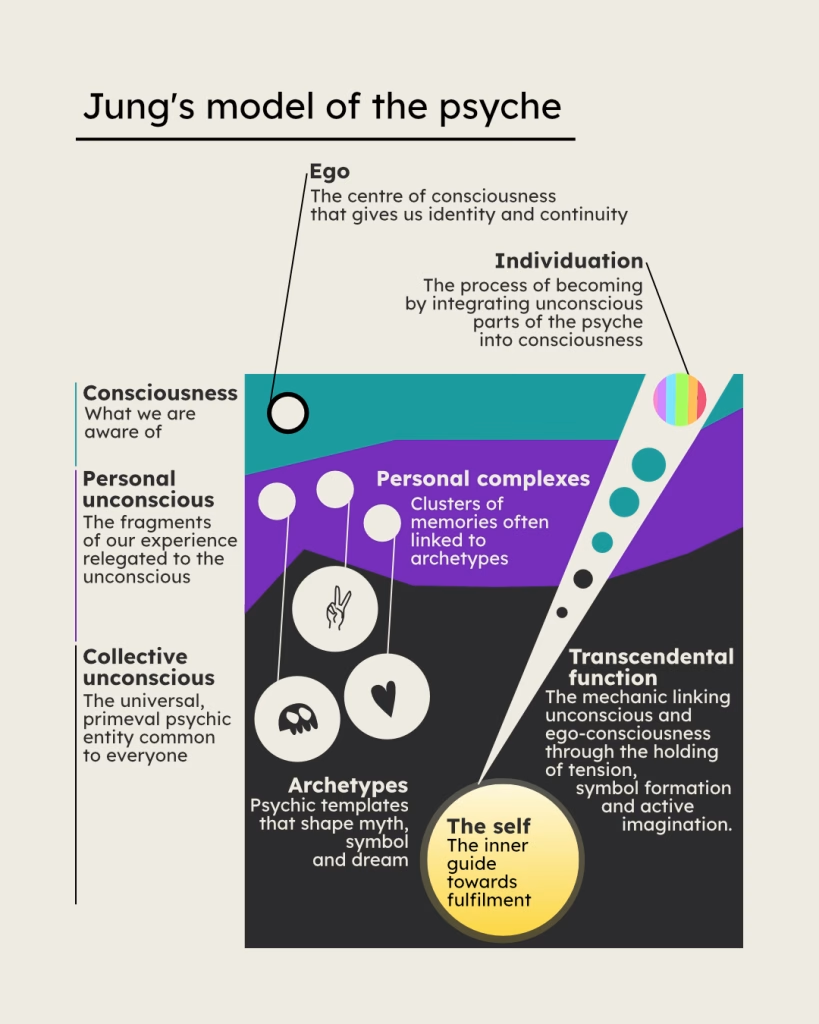
The psyche for Jung is composed of three layers: consciousness, the personal unconscious and the collective unconscious.
Consciousness is the thin layer at the top from which we operate. It allows deliberate thinking, planning and the execution of plans. It is the only layer that we are immediately aware of.
However, for Jung, this is hardly all there is to our existence.
He goes on to say: ‘the definite and directive nature of the conscious mind are extremely important acquisitions that the human mind has bought at a very heavy sacrifice’.
Without awareness of our unconscious layers and their influence in the conscious, we are bound to operate under unconscious scripts, pulled in different directions or missing out on our human flourishing. Without realising it.
We may know what we do, but not why we do it (and neither would we question it).
The unconscious acts through us, in compensatory action for our conscious thoughts and behaviours.
The personal unconscious belongs to the individual only. It continually comes to life from the inter-relationship between personal experiences in the conscious layer (e.g childhood experiences of a father) and ‘primordial images’ coming from the collective unconscious (e.g the immemorial emotional template of ‘being a father’ inherited from our ancestors).
The collective unconscious is the final, deeper layer where those ‘primordial images’ or archetypes reside.
This is the revolutionary idea that set Jung apart, sent Freud away and captured the imagination of many that came after him.
Jung defines the collective unconscious as ‘the deposit of all human experience right back to its beginnings’, and ‘the revival of possibilities of ideas that have always existed, that can be found again in the most diverse minds and in all epochs and are therefore not to be mistaken for (culturally) inherited ideas’
Archetypes
Archetypes are organising structures within the collective unconscious.
They are not ideas. Archetypes are not filled with content, but rather are empty forms of universal experience, like templates upon which the human experience may take form.
Example archetypes are: the mother, rebirth, the trickster and the shadow.
The shadow and the persona are two crucial archetypes that always take an individual expression in everyone.
They result from the intention of the Ego to function in society.
The shadow is what we wish to hide whilst the persona is what we wish to show. In Jungian psychology (as well in much psychodynamic and humanistic theory), healing comes from getting to know the relegated shadow and accepting it, leading to a relaxing of the persona as an artificial performance.
How or why did archetypes form?
Jung doesn’t give a definite answer to this, but he says that ‘dangerous situations arouse affect-ladden fantasies and insofar that those situations repeat themselves they give rise to archetypes’, and that ‘it is not storms, nor thunder or lightning, nor rain and cloud that remain as images in the psyche, but the fantasies caused by the affects they arouse’
The Self
The Self is the ‘archetype of archetypes’ upon which our whole existence rests. As the foundational archetype, it is the template for transcendence.
The Self provides the energy for the individual to transcend their ego-consciousness by illuminating the complexes and archetypes within the unconscious. This way the person can become an individual, free from inner conflict and suffering.
Ego
The ego is the centre of consciousness and gives us our identity and sense of continuing reality. The ego allows us to function in the world, despite our existing inner conflicts.
And it does such a good job at it that it makes us feel it is all there is in our psyche.
Personal complexes
Personal complexes are the unique ways in which the relegated fragments of conscious experience and/or the activation of archetypes cluster to form our personality. They are emotionally charged, often stealing the show from the ego to pursue their own secret agendas.
Individuation
Individuation is ‘the biological process by which every living individual can become what they’re destined to become from the beginning’.
It is the integration of the timeless, universal, already complete Self with our personal, flawed and incomplete Ego. It is a process of making the unconscious conscious and integrating it to allow our personality to develop for its fulfilment.
The transcendental function
The transcendental function is the mechanic that links the Self (the fundamental archetype) with the Ego (the source of identity and conscious experience) and in bringing them together powers the process of individuation.
The conscious and unconscious have a complementary function: for example painful memories of childhood can be relegated to the unconscious to avoid suffering or overwhelm. However then as a compensation the conscious can develop neurotic attitudes such as being a perfect mother.
Therefore the trascendental function allows the holding of these opposites and allows the Self to form the symbols upon which consciousness can expand by learning about and accepting the deeper levels of the psyche.
—-
Sources:
Jung, C. G. (1960). The Structure and Dynamics of the Psyche (Collected Works of C. G. Jung, Vol. 8). Princeton University Press.
Jung, C. G. (1970). Four Archetypes (Routledge Classics). Princeton University Press.
Stevens, A. (1994). Jung: A Very Short Introduction. Oxford University Press.